Ranking
#47

Ranking
#47
Followers
131 M
Digital presence
Official profiles, streaming and discovery.
What a good fan recites by heart (or pretends to).
Addison Rae is one of the most interesting cases in recent pop because her story begins exactly where many critics already wanted it to end: the internet. For years, the word “influencer” worked almost like a sentence for anyone trying to cross into music. If you came from TikTok, fame was assumed to be lightweight, talent secondary, and any song merely an extension of a brand. Addison took that prejudice and turned it into part of her narrative. She did not deny her digital origin; she used it as the starting point for building something stranger, more conscious and, over time, more musical than many expected.
Born in Lafayette, Louisiana, Addison grew up far from the traditional centers of pop, but with a deeply physical relationship to performance. Before studios, fashion campaigns or red carpets, there was dance: years of competitive training, choreography, body discipline and a clear instinct for how a song translates into movement. That foundation matters because it explains why her entry into popular culture happened so quickly. TikTok did not invent her from nothing; it amplified a quality that was already there: knowing how to occupy the camera naturally, how to turn seconds of music into gesture and how to make people want to imitate.
Her rise on TikTok in 2019 was meteoric. On a platform built around short choreography, recognizable faces and viral repetition, Addison appeared with a mix of easy charisma, Southern-girl warmth, dance ability and an energy that millions of users could instantly read. But that same visibility carried a trap: the more famous she became, the easier it was to flatten her into an image. The Addison of the early years was everywhere, yes, but also caught between fast entertainment, public scrutiny and the question of whether she could build a career beyond the algorithm.
“Obsessed,” her first single, arrived in 2021 inside that context. The song had pop gloss, self-confidence, choreography and a central phrase designed to play with the funny narcissism of digital culture. But it also received a chilly response from people who had already decided not to take her seriously. That moment ended up mattering more than it first seemed. Instead of closing the story, it forced her to recalibrate. Addison faced a question many viral stars avoid: what happens when attention already exists, but the artistic vision still has to be built?
The answer began forming quietly, through sessions, leaked songs, obsessive pop fans and an increasingly clear relationship with references that went far beyond easy hits. AR, her 2023 EP, was the first serious sign that Addison had taste, curiosity and an ear. “I Got It Bad,” “2 Die 4” with Charli XCX, “Nothing On (But the Radio)” and “It Could’ve Been U” worked like a small laboratory of glossy, sensual, playful pop with an awareness of archive. It was not yet a complete reinvention, but it was a strong signal: behind the celebrity was someone studying the language of pop more carefully than expected.
Her connection with Charli XCX helped change the public reading. Not because Addison needed outside validation in order to exist, but because that support connected her with a more demanding, more ironic and more experimental pop world. Instead of chasing only radio, she began surrounding herself with a more curated sensitivity: references to Britney, Madonna, Lana Del Rey, Kylie, Y2K culture, archival aesthetics, club music, fashion, camp and a version of femininity built not as innocence, but as powerful artifice. Addison began to understand that being a “pop girl” did not mean sounding simple; it could mean building a universe.
“Diet Pepsi” was the true turning point. The song arrived with a strange softness: adolescent sensuality seen through a blurred camera, nocturnal pop, desire, nostalgia, highways, glossy lips and a production that did not need to shout in order to stay with you. It did not sound like a former influencer trying too hard to prove something. It sounded like an artist who had found a temperature. “Aquamarine” strengthened that direction with a more liquid, ghost-club shimmer. “High Fashion” raised the obsession with glamour. “Headphones On” turned pop isolation into an intimate scene. “Fame Is a Gun” played with the danger of being watched.
The album Addison consolidated that transformation. Its importance lies not only in being her formal debut as a long-form artist, but in the way it organized everything that had previously felt scattered: the viral girl, the dancer, the student of pop, the fashion girl, the fan of icons, the questioned figure and the person who wanted to be taken seriously without losing fun. The record blends dance pop, synth-pop, house, soft trip-hop, glamorous melancholy and a visual self-awareness. Addison does not try to erase her social media past; she turns it into aesthetic material. Fame appears as desire, danger, mirror, toy and cage.
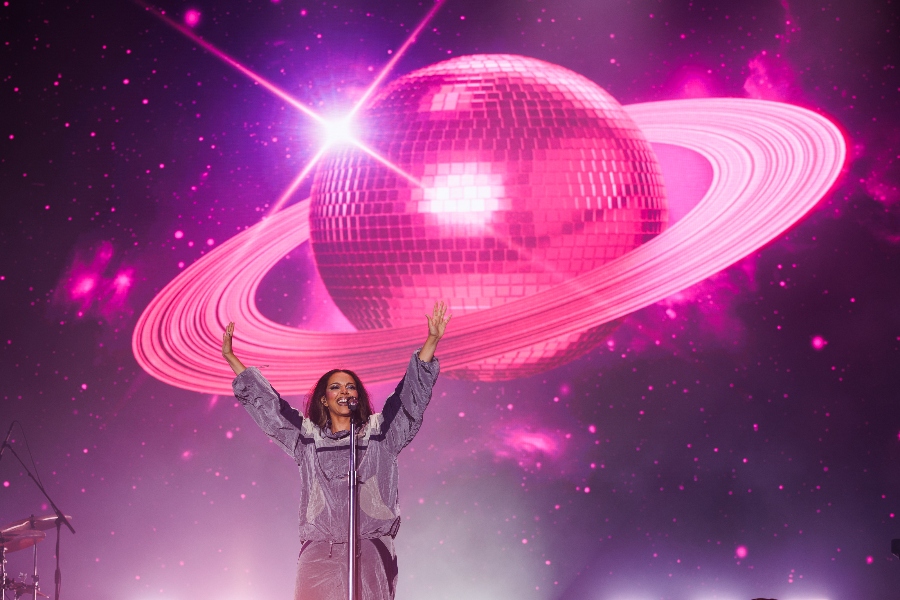
Her appearance with Lana Del Rey at Wembley and her first tour of her own reinforced the idea that the transition was no longer a side joke from the internet, but a real pop career in progress. Addison is still in an early stage, and that is part of her appeal. She does not yet carry the weight of an artist with decades of catalog, but she has the energy of someone who managed to turn the conversation in her favor. She went from being easy to underestimate to being a presence that makes people look twice.
Addison Rae matters because she represents a new form of pop manufacturing: a star born from algorithmic culture who decided to study the classic myth of the diva, filter it through digital nostalgia and return it as something strangely fresh. Her best version lives inside that contradiction: innocent and calculated, shiny and melancholic, viral and crafted, apparently superficial but increasingly precise in intention. Addison did not enter pop through the traditional door. She came in through a small screen, and now she is trying to turn that screen into a stage.
Main genre
POP
Main subgenres
Like a superfan's list — except verified, with sources and links.

03–Jun 07, 2026
Barcelona, Catalunya · Spain
Past
17–Apr 19, 2026
Indio, California · United States
Past10–Apr 12, 2026
Indio, California · United States
Past
20–Mar 22, 2026
São Paulo, São Paulo · Brazil
Past
13–Mar 15, 2026
Buenos Aires, Ciudad Autónoma de Buenos Aires · Argentina
Past13–Mar 15, 2026
13–Mar 15, 2026
Santiago, Región Metropolitana de Santiago · Chile
PastWhat we managed to link to the concert archive. If a date is missing, tell us — happens to us too.
No linked concerts
Every concert and festival of the year, traced on the globe. Hit play and follow the route stop by stop.
Photos from the public archive.
Recent coverage linked to the artist.



Close by genre and social signal.
No related artists
When there is enough genre signal, they will appear here.