Ranking
#1,247

DUBSTEP - HOUSE - REGGAE
Ranking
#1,247
When
20–JUL 25, 2027
Featured artists
Lineup coming — we'll publish it as soon as it's confirmed.
Time left
10 editions to explore · future, live and past
Numbers, home base and house quirks
Big Dub begins before the first bassline drops. It starts while tents, coolers and bags are being hauled into the Pennsylvania hills, as people search for a patch of ground beneath the trees and accept that their campsite will matter almost as much as any stage. Four Quarters Farm is not a polished field designed for effortless movement. There are dirt roads, slopes, woodland paths, water and secluded corners. Arriving, building a temporary home and learning how the land connects together form the opening chapter of the festival.
Founded in 2009 and connected to Four Quarters since its early years, Big Dub grew alongside the American dubstep community at a time when bass music was still developing its own festival culture. The early identity centred on heavy low frequencies, powerful sound systems and a crowd that did not need mainstream pop names to justify travelling into the countryside. Riddim, drum & bass, experimental bass, house and techno have gradually entered the programme, but the foundation remains electronic music designed to be physically felt, particularly after dark.
The venue is central to everything. Four Quarters is not simply a farm rented for the weekend; it is an interfaith sanctuary surrounded by wooded hills and Sideling Creek. The standing-stone circle that gives the main stage its name is part of the permanent character of the property. Hemlock Hole draws energy from the water and trees around it. During the day, people swim, rest in hammocks, join workshops or slowly recover from the previous night. After sunset, lasers and stage lighting pass through the branches, transforming the landscape without completely hiding the wilderness underneath.
Music is spread across Stone Circle, Hemlock Hole, Hi-Score and New Camp. Stone Circle carries many of the largest productions and the sets that pull together the densest crowds. Hemlock Hole feels more concealed, as though a dancefloor has been uncovered rather than constructed in the woods. Hi-Score and New Camp broaden the route through the grounds, giving different corners of bass music and electronic culture room to breathe. Moving between them becomes part of the night, especially when a distant rhythm persuades people to abandon the timetable they had carefully planned.
Big Dub openly describes itself as a participatory festival rather than a place where visitors simply watch. Theme camps host their own gatherings, while pop-up parties, live painters, interactive art, fire spinning, wellness sessions, games, cosplay days and workshops fill the hours between scheduled performances. The nightly drum circle offers a different kind of collective rhythm, removed from the structure of a conventional DJ set. Some experiences are organised in advance; others exist because a group of campers chooses to turn its temporary neighbourhood into a party, lounge or meeting place.
The terrain demands preparation. July can bring heat, humidity, dirt and sudden changes in weather, while the slopes feel steeper after several hours of dancing. Mobile service may be limited, and returning to camp late at night means remembering paths and landmarks that looked obvious in daylight. Yet that separation from ordinary routines is part of the appeal. Conversations happen face to face, neighbours become part of the weekend, and getting temporarily lost often leads to a stage, installation or gathering that was never included in the original plan.
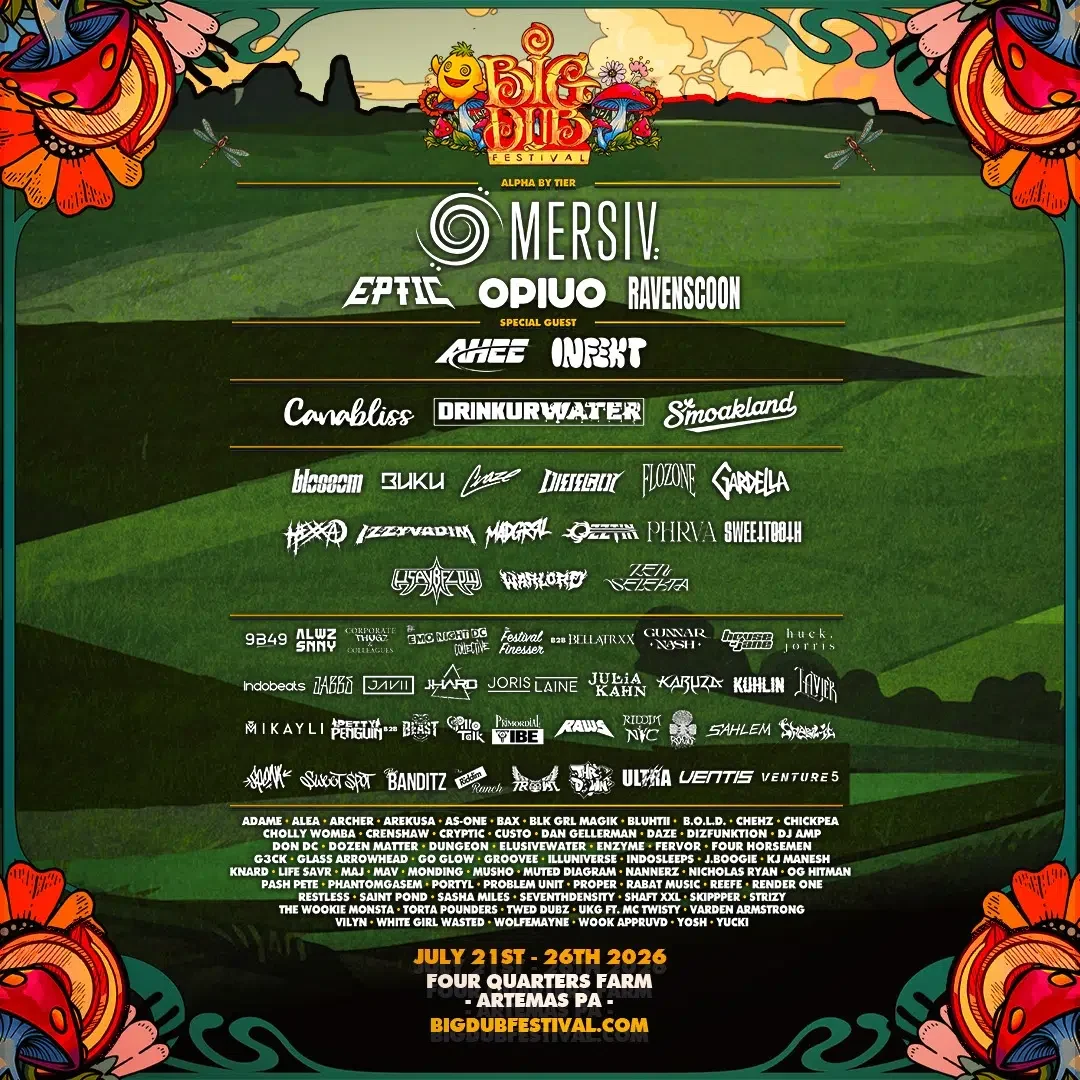
The 2026 edition runs from 21 to 26 July, with Eptic, Mersiv and Opiuo leading a bill that also includes Ravenscoon, Canabliss, AHEE, Smoakland, Craze and a deep selection of underground bass artists. Basic tent camping is included with admission, making life on the property the festival’s main format rather than an optional extra. Arriving early means watching the community gradually assemble; leaving on Sunday means seeing that improvised town collapse back into packed cars, exchanged numbers and quiet woodland.
Big Dub has expanded its production and musical range, but its identity still rests on something that cannot be manufactured by staging alone: the belief that attendees help create the event. Bass provides the pulse, yet the lasting memory is built from the trees, swimming holes, camp neighbours, unexpected detours and those late hours when a remote corner of Pennsylvania feels like a world temporarily separated from everything outside it.
Genres
DUBSTEP
HOUSE
REGGAE
Timeline
One artist per year — highest ranked in our archive
Those who appear most across this franchise's editions.
 #1
#1Belgium
1 editions · 2026
 #2
#2United States
1 editions · 2026
 #3
#3United States
1 editions · 2026