Ranking
#631

FOLK - POP - ROCK
Ranking
#631
Followers
87.5 K
When
22–JUL 25, 2027
Featured artists
Lineup coming — we'll publish it as soon as it's confirmed.
Time left
43 editions to explore · future, live and past
 2027
2027DAS FEST 2027
 2026
2026DAS FEST 2026
Numbers, home base and house quirks
DAS FEST becomes visible before the gates come into view. From different parts of the Günther-Klotz-Anlage, the slope known as Mount Klotz can be seen filling with people, blankets and small groups searching for a position opposite the Hauptbühne. The stage sits below while the audience rises above it in an uneven grass grandstand. As daylight fades over Karlsruhe, the hill behaves like a natural amphitheatre: thousands of people facing the same performance without losing the informal feeling of an afternoon spent in a city park.
The event began in 1985 as Karlsruhe’s central contribution to the International Year of Youth. The Stadtjugendausschuss wanted to take the kind of cultural programme it had previously organised indoors and place it somewhere open, accessible and free. Around 3,000 people attended the first edition. The budget was small, services were gathered inside one large tent and the atmosphere resembled a youth camp more than a major festival. None of those involved expected the gathering to grow into an event attracting hundreds of thousands of visits.
Growth altered the scale without removing the original desire to mix audiences. DAS FEST has never been designed around a single musical tribe. Alternative rock, punk, reggae, German pop, hip-hop, electronic music and international touring acts have all occupied Mount Klotz. Seeed, Faithless, Simple Minds, Apocalyptica, Guano Apes, Ska-P, Peter Fox, Die Fantastischen Vier, Clueso and Beatsteaks belong to a history in which a loud guitar band can share the weekend with rap, radio pop, soul or a full classical orchestra.
Popularity also created difficult practical decisions. For many years the festival remained free and depended heavily on food and drink sales. As more visitors brought their own supplies, that model became unstable, and the grounds were fenced in 2001. Following an overcrowded edition in 2009, a new operating structure took responsibility, and a low-cost ticket was introduced for the main-stage hill area. The change was controversial, but it preserved a contradiction that still defines the event: a ticketed headline zone surrounded by a much larger programme that remains open without charge.
Today, more than seventy per cent of the scheduled activities can be experienced without a ticket. Beyond Mount Klotz are Feldbühne, Kulturbühne and FEST-Floor, together with children’s, sports and community areas. A family can move between theatre, water play, circus and participatory performances. Teenagers may spend hours around skateboarding, BMX or breaking competitions. Someone who arrived for a headline artist may instead become absorbed by a regional band, poetry slam, science show, comedy performance or electronic set running late into the evening.
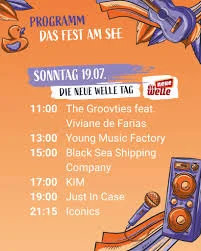
That range shapes the way the site is used. DAS FEST has no integrated campsite and does not build a closed temporary city away from ordinary life. Visitors arrive by tram, bicycle or on foot, enter the public park and decide how close they want to move towards the large concerts. Trees offer shade, food stalls and local organisations fill the routes, and paths link the hill with the lake and free cultural zones. DAS FEST AM SEE begins the wider celebration during the preceding week, bringing free music to the water before the main four-day programme opens.
Weather has written its own chapters. On bright years, Mount Klotz becomes an enormous summer lawn. Rain changes the slope, brings waterproof jackets into view and has produced muddy concerts during which the crowd refused to leave. The perspective from the stage is unusual as well. Because the audience climbs the hill, people at the top can appear almost level with the performers, creating a rising wall of faces rather than the flat field found at many festivals.
Sunday morning brings one of the weekend’s most distinctive transformations. After the rock, rap and electronic music of the previous nights, the Badische Staatskapelle takes over the Hauptbühne for Mount Klassik. Families, older regulars and people who may rarely enter a concert hall settle onto the grass to hear a historic orchestra in an informal open-air setting. Only a few hours later, the same stage returns to pop, soul or hip-hop.
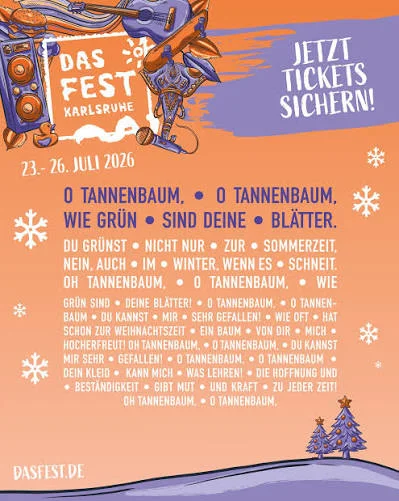
The 2026 edition runs from 23 to 26 July, led by Nico Santos, Beatsteaks, Zartmann and Max Herre & Joy Denalane. Blond, Disarstar, Leony, Loi, Blood Red Shoes, Lari Luke, Zimmer90, Ray Dalton and Âme live extend the programme across pop, punk, rap, soul, indie and electronic music, while the surrounding areas continue with theatre, science, sport and local culture.
DAS FEST cannot be understood through its headline concerts alone. Its character comes from the way Karlsruhe occupies the park: children playing in the afternoon, rock audiences claiming the hill, club crowds gathering at FEST-Floor and an orchestra opening Sunday in front of thousands seated on the grass. Mount Klotz provides the famous image, but the festival’s real identity lies in the coexistence of all those experiences inside a public space that briefly feels as though it belongs to the entire city.
Genres
FOLK
POP
ROCK
Timeline
One artist per year — highest ranked in our archive
Those who appear most across this franchise's editions.
 #1
#1Germany
2 editions · 2023–2026
#2Germany
2 editions · 2023–2026
#32 editions · 2023–2026