Ranking
#14

HIP HOP - R&B - RAP
Ranking
#14
Followers
7.9 M

When
2012
Featured artists
Lineup coming — we'll publish it as soon as it's confirmed.
14 editions to explore · future, live and past
Numbers, home base and house quirks
Rolling Loud Florida is a hip-hop story born from heat, chaos and a very sharp instinct: rap needed its own major festival. Not a side stage inside a rock, pop or electronic event. Not a secondary tent where hip-hop artists were invited as cultural decoration. A festival built from the center of rap, with its own rules, its own disorder, its own energy and its own language. That idea took shape in Miami in 2015, when Matt Zingler and Tariq Cherif launched the first Rolling Loud at Soho Studios in Wynwood, not yet knowing that they were building one of the most influential live music brands of the next decade.
The first edition now feels like a perfect mid-2010s rap time capsule: ScHoolboy Q, Juicy J, A$AP Ferg, Action Bronson, Curren$y, Travis Scott, Denzel Curry, Domo Genesis, Casey Veggies and more. There were already established names, fast-rising internet favorites, artists tied to Florida’s SoundCloud energy and a crowd that did not want hip-hop to keep being treated as an add-on. Rolling Loud understood that early. It understood that rap was not only dominating streaming and youth culture; it could also become a massive physical gathering, with thousands of people shouting lyrics together as if they were generational chants.
Florida was never just a backdrop. Miami gave the festival a mix that would have been difficult to manufacture anywhere else: tropical weather, club culture, Latin energy, Southern trap, cars, streetwear, excess, a beach-town aura even when the venue was inland, and a direct relationship with regional rap scenes. From Soho Studios, Rolling Loud moved to Mana Wynwood, then Bayfront Park, and eventually Hard Rock Stadium in Miami Gardens, where it became massive. At that point, it no longer felt like a local bet. It became a pilgrimage for hip-hop fans from across the United States and beyond.
Musically, Rolling Loud is direct. It does not try to be a “something for everyone” festival. Its territory is contemporary hip-hop: trap, rage, drill, street rap, melodic rap, SoundCloud rap, global stars, viral newcomers, artists breaking on TikTok, veterans who still command respect and regional scenes that shift every year. Its strength is capturing the moment before it becomes polished. The artist playing in the middle of the afternoon one year may be the name dominating lineups, playlists and internet arguments the next. That is part of its pulse: Rolling Loud stays close enough to the present to feel messy, alive and sometimes unstable.
To attend Rolling Loud Florida is not to enter a polished or elegant environment. It is heat, dust or pavement, lines, packed crowds, heavy bass, carefully planned outfits, friends disappearing in seconds, phones in the air, mosh pits, shouted lyrics, exhaustion and the strange mix of euphoria and disorder that modern rap creates when it is experienced at scale. It is not always comfortable. There can be delays, short sets, cancellations, lineup changes and crowds that feel difficult to control. But that imperfection is also part of the identity. Rolling Loud has never tried to feel like a gala. Its power comes from volume, excess and the sense that something unpredictable could happen at any moment.
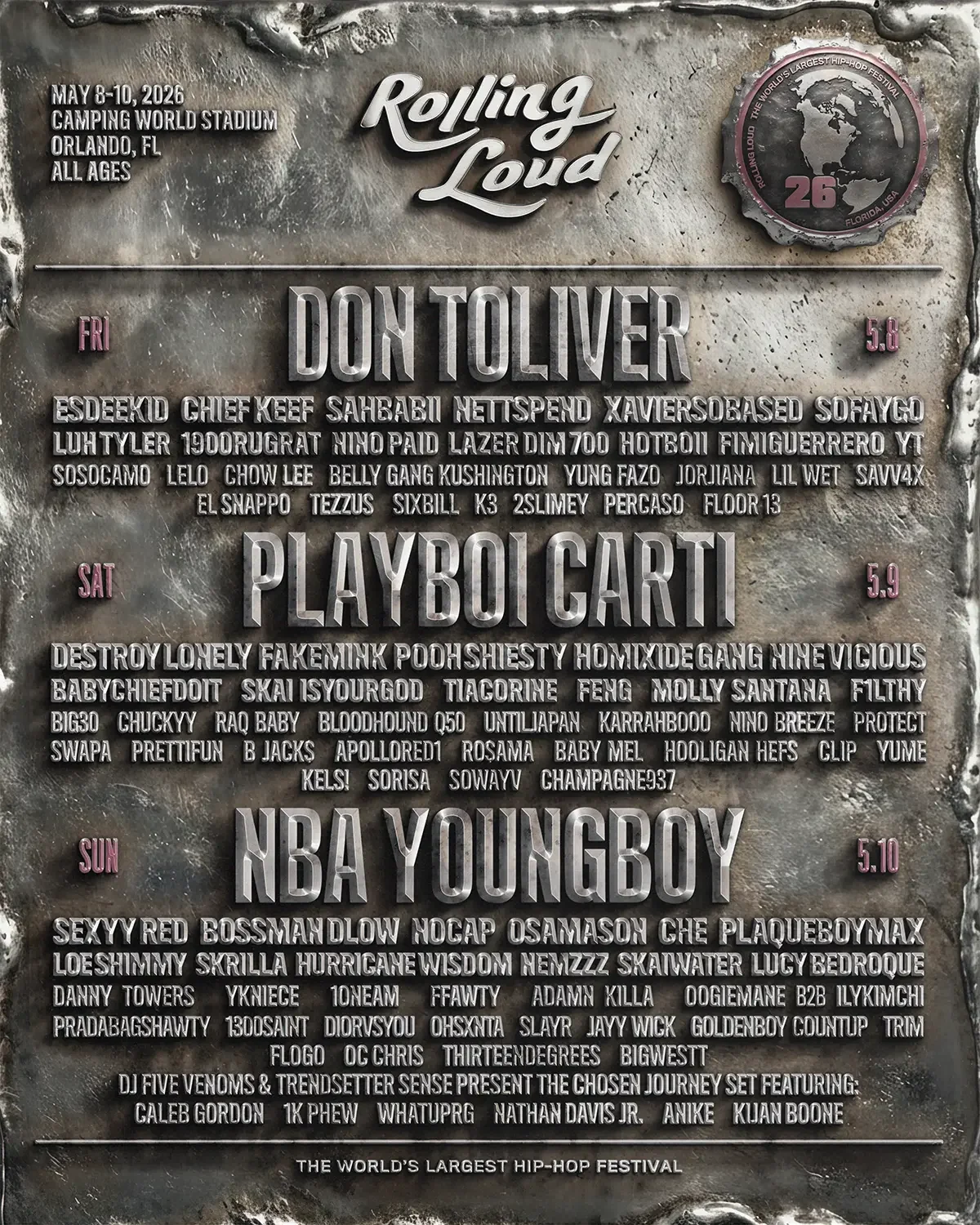
The 2024 Miami edition celebrated ten years with Future, Travis Scott and Playboi Carti as central names, marking a symbolic milestone at Hard Rock Stadium. In 2026, the U.S. edition moved to Orlando, at Camping World Stadium / Tinker Field, a major shift within Florida. That move matters. Rolling Loud was born in Miami, and Miami remains the emotional origin of the story, but the current chapter shows a brand trying to stay enormous, accessible and flexible without being permanently tied to one city.
The crowd is young, loud and highly connected, but not one-dimensional. There are teenage fans, twenty-somethings chasing the most current rap moments, content creators, trap loyalists, adults who have watched hip-hop move from street culture to global dominance, and travelers who treat Rolling Loud like a cultural checkpoint. People go for headliners, but also for the feeling of being inside the algorithm before it becomes history.
What makes Rolling Loud Florida different is that it does not look at hip-hop from the outside. It lives inside it. That gives it credibility, but also all the contradictions of the genre it represents: ambition, ego, volatility, community, fashion, internet hype, real fandom and raw energy. Rolling Loud is not perfect, and it has never needed to be. Its importance lies in the fact that it became the physical home of modern rap’s loudest generation: global, chaotic, competitive, emotional and fully alive.
Genres
HIP HOP
R&B
RAP
Timeline
One artist per year — highest ranked in our archive
Those who appear most across this franchise's editions.
 #1
#1United States
6 editions · 2023–2026
 #2
#26 editions · 2023–2026
#3United States
6 editions · 2023–2026