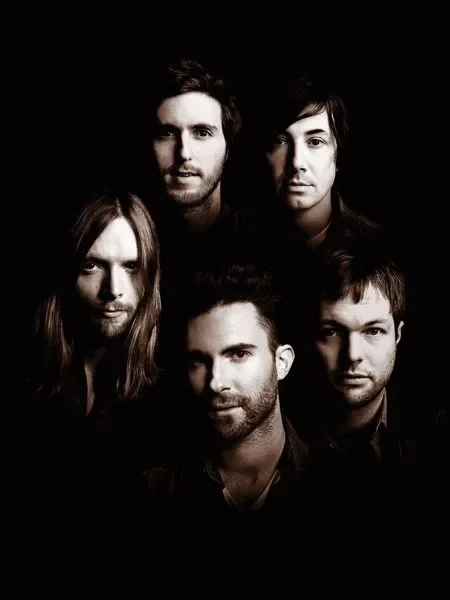
Ranking
#46

Ranking
#46
Followers
134.6 M
Digital presence
Official profiles, streaming and discovery.
What a good fan recites by heart (or pretends to).
Maroon 5 is one of those bands that seem to have lived several careers inside a single one. They began as a group of friends from Los Angeles with roots in rock, funk and soul, exploded with breakup songs that sounded like a late-night bar and a wounded heart, and then transformed into a global pop machine capable of dominating radio, weddings, gyms, playlists, stadiums and commercials without completely losing their original mark: Adam Levine’s elastic voice, the pulse of a band, a taste for groove and a very particular ability to make romantic pain sound danceable.
The story started before Maroon 5, when several of its members played as Kara’s Flowers. That teenage era, closer to 1990s alternative rock, did not have the impact they wanted, but it mattered because it gave them the foundation of a real band: playing together, failing together, learning each other inside a room and starting over. When the project reappeared as Maroon 5, it was no longer simply about being a guitar band. Another ingredient had entered: a blend of blue-eyed soul, funk, R&B, adult pop and sentimental tension that set them apart from many rock groups of their generation.
Songs About Jane changed everything. The title already carried a promise of intimacy: songs built around a relationship, a woman, an emotional memory that could feel specific and universal at the same time. “Harder to Breathe” had nerve, bass, dry guitar and frustration. “This Love” mixed groove with romantic resentment. “She Will Be Loved” opened the door to the kind of ballad that seemed made to play wherever someone was confusing love with rescue. “Sunday Morning” revealed an almost luminous softness, the calm of coffee, unmade sheets and a long Sunday. The album worked because it did not sound fully like rock or fully like pop. It existed in between, and that middle space became their territory.
Adam Levine became the inevitable face of the band, but Maroon 5’s identity never depended only on his image. There was architecture behind it: clean guitars, a moving bass, flexible drums, keyboards pushing toward soul and a way of building songs around desire, guilt, seduction and insecurity. Levine’s high, recognizable voice could sound vulnerable, arrogant, wounded or insistent within seconds. That ambiguity was key: Maroon 5 wrote love songs where something broken, uncomfortable or selfish almost always lived beneath the sticky surface.
It Won’t Be Soon Before Long confirmed that they could grow without simply repeating the first album. “Makes Me Wonder” pushed the band toward a brighter, funkier and more shameless pop. “Wake Up Call” played with narrative violence and radio pulse. “Won’t Go Home Without You” brought back big romance, but with smoother production. At that point, the path they would later follow became clearer: less intimate club band, more group capable of operating inside the mainstream with enormous efficiency. For some early fans, that shift felt like a loss. For others, it proved that Maroon 5 knew how to adapt.
Hands All Over and, especially, “Moves Like Jagger” opened the door to another era. That song, with Christina Aguilera, was a point of no return: instant whistle, light rhythm, retro wink, television energy and a structure built to conquer huge audiences. Maroon 5 stopped being only a pop-rock band and became a factory of global singles. From then on, the question was no longer whether they could make another “This Love,” but how far they could stretch their identity without breaking it.
Overexposed was the perfect title for that phase, because Maroon 5 was literally everywhere. “Payphone,” “One More Night,” “Daylight” and “Love Somebody” strengthened a more produced, more pop, more electronic version of the band, less dependent on the traditional band format. The group began to work almost like a platform: songs with major producers, hip-hop guests, choruses built for repetition and a constant presence at the center of radio pop. Critics could debate whether they had lost edge, but the public kept responding. Maroon 5 understood something few bands accept so naturally: mass pop does not reward pure nostalgia, but the ability to move.
V and Red Pill Blues expanded that logic even further. “Maps,” “Animals” and “Sugar” maintained the mix of desire, rhythm and irresistible chorus. “Sugar,” in particular, recovered a funk-pop joy that connected with weddings, viral videos and collective celebration. Later, “Don’t Wanna Know,” “Cold” and “Girls Like You” showed a band comfortable inside the collaborative pop of the streaming era. “Girls Like You,” with Cardi B, was less a traditional band song than a perfect product of its time: soft, catchy, inclusive, ready to circulate through networks and playlists.
Maroon 5’s case is interesting because its evolution divides opinions. Some listeners miss the emotional roughness of Songs About Jane, while others value the band’s ability to remain relevant for decades. Both readings can coexist. Their first major moment had more band nerve; the later era has more pop intelligence. What is striking is that, even when they moved away from their original sound, they kept certain pillars: memorable melodies, romantic tension, a recognizable voice, clean rhythm and an almost obsessive devotion to the hook.
Their recent period, with Jordi and Love Is Like, confirms that Maroon 5 continues trying to remain inside the global pop conversation, not as a band looking only backward, but as a project that adapts to collaborations, current sounds and contemporary touring formats. They no longer need to prove that they mattered in the 2000s; their catalog does that for them. What they do now is sustain a presence that combines nostalgia, craft and the ability to create new moments for audiences that arrived in different eras.
Maroon 5 matters because it represents one of the clearest transformations in modern pop rock: from a Los Angeles band with soul groove to a global radio institution. Their legacy lives in songs people sing without thinking too much, melodies that remain stuck for years and a flexibility that allowed them to survive changes in industry, taste and format. At their best, Maroon 5 sounds like a night that begins with a romantic wound and ends with everyone singing the chorus.
Main genre
POP
Main subgenres
Like a superfan's list — except verified, with sources and links.

04–Sep 13, 2026
Rio de Janeiro, Rio de Janeiro · Brazil
Past22–Jun 24, 2023
Odense, Syddanmark · Denmark
Past17–Jun 18, 2023
Firenze · Italy
Past15–Sep 24, 2017
Rio de Janeiro, Rio de Janeiro · Brazil
PastSep 23 – Oct 02, 2011
Rio de Janeiro, Rio de Janeiro · Brazil
PastWhat we managed to link to the concert archive. If a date is missing, tell us — happens to us too.
No linked concerts
Every concert and festival of the year, traced on the globe. Hit play and follow the route stop by stop.
 AMANominated
 BillboardNominatedAMANominatedAMANominatedBillboardNominatedAMANominatedBillboardWonBillboardNominatedBillboardWonBillboardWonBillboardWonBillboardNominated
Photos from the public archive.
Recent coverage linked to the artist.

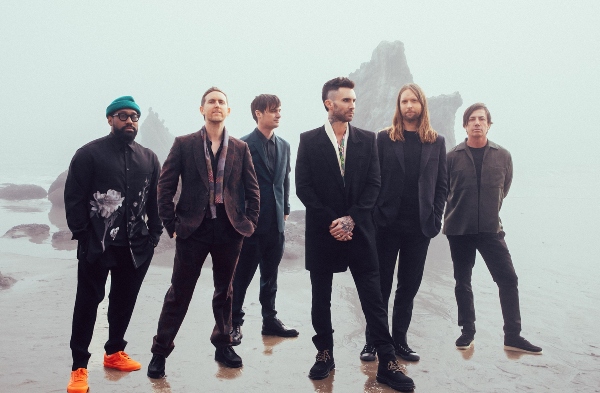


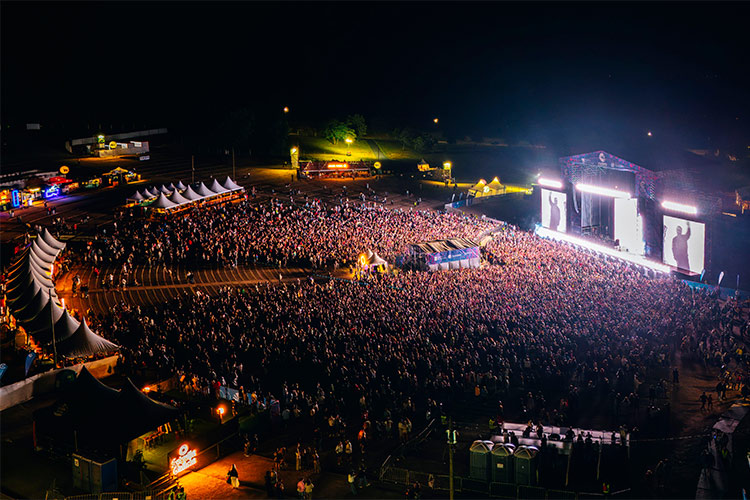
Close by genre and social signal.
No related artists
When there is enough genre signal, they will appear here.