Ranking
#984

ROCK
Ranking
#984
Followers
23.6 K
12 editions to explore · future, live and past
Numbers, home base and house quirks
A Candeloria was one of those festivals that cannot be understood only by reading the lineup. The bands mattered, of course: punk, ska, heavy guitars, combative rock, political rap, metal, shouted choruses, fast rhythms and songs that often felt closer to collective slogans than simple entertainment. But the real weight of the festival was elsewhere too: in Lugo, in the Galician winter, in the Pazo de Feiras e Congresos turned into a meeting point, in people arriving from across Galicia and beyond, and in a crowd that treated the event as something of its own rather than just another date on the calendar.
Founded in 2013, A Candeloria grew from a local initiative into one of the key gatherings for alternative music in Galicia. It was not a polished lifestyle festival or a premium experience packaged for social media. Its energy was more direct, more communal, more grounded. Even the name, connected to a winter celebration, gave it a distinctive personality. A Candeloria was not a beach festival or a summer mega-event. It was a cold-season ignition point: a way to turn the early part of the year into noise, movement and shared heat. That contrast was part of its charm. Outside, Galicia could feel wet and cold. Inside, there was sweat, volume, food, stalls, old friends, new faces and a very physical sense of belonging.
Its musical universe was broad but clearly defined. A Candeloria moved through punk rock, ska, hardcore, metal, political rap, reggae-punk, Spanish and Galician alternative rock, and live acts built around urgency rather than decoration. Across its editions, names associated with the festival included Dakidarría, Boikot, Narco, Lendakaris Muertos, Koma, Sons of Aguirre & Scila, Kaos Urbano, Zoo, Soziedad Alkoholika, Los Chikos del Maíz, Talco, Mafalda, Gatillazo, La Polla Records, Evaristo, GBH, Manolo Kabezabolo, Ruxe Ruxe, Familia Caamagno, Rebeliom do Inframundo, Arrhythmia, Tremenda Jauría and Juantxo Skalari & La Rude Band. That mixture says everything about the spirit: stage music, yes, but also road music, protest music, working-class energy, humor, local identity and collective release.
The experience was different from that of larger festivals built around distance and spectacle. A Candeloria was not designed to make people disappear inside an enormous site. It was designed for recognition. Lugo became, for a while, a small capital of alternative music. People arrived early for the sesión vermú, for cantos de taberna, for the atmosphere around the barrio da Ponte, for food, for the first drinks, for the slow build before entering the main venue and staying until the early hours. The festival was not only about watching concerts. It was about making a route, meeting friends, recognizing band shirts, buying records or merch, arguing over set times, returning to the same meeting spot, shouting familiar lyrics and discovering a band that was not originally in the plan.
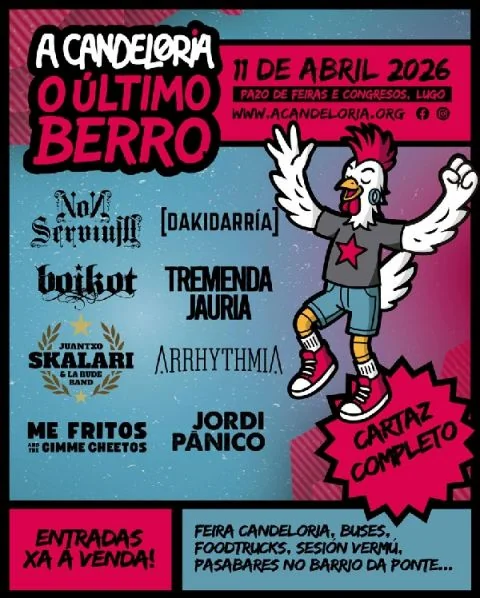
Its farewell in 2026, under the slogan “O Último Berro,” carried real emotional weight. It was not presented as a cold cancellation or as the collapse of a project, but as the closing of a stage after twelve years, at a moment when the festival had already become established. The final lineup brought together Non Servium, Dakidarría, Boikot, Tremenda Jauría, Juantxo Skalari & La Rude Band, Me Fritos and The Gimme Cheetos, Jordi Pánico and Arrhythmia. That bill worked almost like a summary of A Candeloria’s world: street punk, ska, political energy, Galician presence, humor, anger, dancing, shouting and the idea that alternative music can still create a room where people feel less alone.
What made A Candeloria important was not size. It mattered because it defended a way of understanding festivals that does not depend on luxury, VIP language or enormous brand infrastructure. Its value came from bringing together bands with attitude, audiences with memory and a city that learned to associate its name with winter, noise and community. At a time when many festivals look increasingly alike, A Candeloria kept a rougher and more specific personality. It did not need to please everyone. It needed to be a home for people who understood its language: guitars, ska, rage, jokes, politics, friendship and celebration.
Today, after its final Lugo edition, A Candeloria should be considered historical and discontinued in its main format. That does not mean its energy has vanished. The organization has already communicated new activity connected to A Veiga, which suggests that part of the spirit may continue in another place and shape. But A Candeloria as the Lugo gathering leaves a clear mark. For twelve years, it showed that an alternative festival can be more than a sequence of bands. It can be a community recognizing itself the moment the first chord hits.
Genres
ROCK
Timeline
One artist per year — highest ranked in our archive
Those who appear most across this franchise's editions.
 #1
#1Spain
2 editions · 2023–2026
 #2
#2Spain
2 editions · 2023–2026
#3Spain
2 editions · 2023–2026
Editorial coverage linked by archive relation.