Ranking
#26

ROCK - SOUL
Ranking
#26
Followers
3.4 M
When
2007
Where
Brooklyn, New York
Country
United States
Featured artists
Lineup coming — we'll publish it as soon as it's confirmed.
35 editions to explore · future, live and past
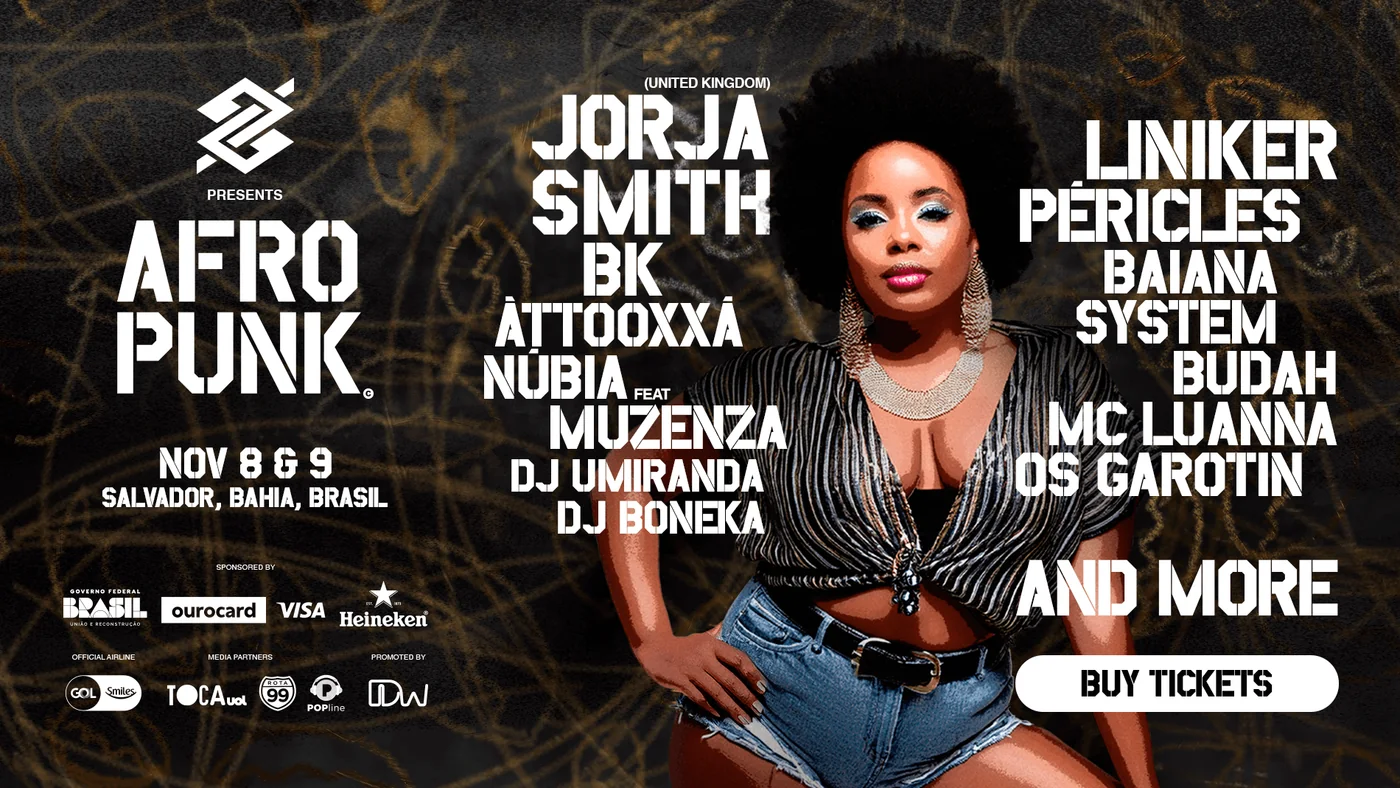 2025
2025Afropunk Brasil 2025
Numbers, home base and house quirks
AFROPUNK is much more than a festival. It is a cultural statement about the many ways of being Black, alternative, creative, strange, rebellious, elegant, political, queer, loud, spiritual, futuristic or impossible to classify. Its origin was not a major promoter searching for a new festival brand, but an uncomfortable question: where were Black people inside punk and alternative culture? James Spooner’s 2003 documentary Afro-Punk followed Black musicians and fans moving through hardcore, punk and alternative scenes where they were often the only Black people in the room. From that tension came a community, and from that community came the first AFROPUNK Music Festival in Brooklyn in 2005.
The early history matters because it explains the heart of the project. AFROPUNK did not begin by trying to be “cool” in the commercial sense. It began as refuge. A meeting point for people who did not feel fully accepted either by white alternative spaces or by narrower ideas of what Black culture was supposed to look like. It was for the Black girl in punk boots, the hardcore musician who did not fit the scene, the queer person of African descent searching for reflection, the Bad Brains, Tamar-kali, Living Colour or Fishbone fan who understood that Blackness has never had only one aesthetic.
Over time, AFROPUNK became bigger, more visible and more complicated. Brooklyn remained its symbolic root, but the brand expanded to other cities, formats and countries. Its sound also opened up. What began with a direct relationship to punk, hardcore and alternative rock eventually embraced soul, R&B, hip-hop, funk, electronic music, afrobeats, jazz, ballroom, performance, fashion, art, conversation and activism. That evolution has been celebrated by many and criticized by others. For some early fans, AFROPUNK moved too far away from punk. For others, that expansion proves its strength: refusing to limit the Black alternative experience to one genre and allowing it to express itself in many forms.
The AFROPUNK experience cannot be understood only through the lineup. There are artists, yes, often extraordinary ones, but the audience is a central part of the spectacle. AFROPUNK is famous for its fashion, hair, colors, bodies taking up space with pride and street style turned into manifesto. At other festivals, people dress for comfort or trend. At AFROPUNK, many people dress to say something. A jacket, braid, makeup look, skirt, boot, piercing or silhouette can function as political language. The body becomes archive, performance and flag.
Its community politics are also part of its identity. AFROPUNK has long carried a stated stance against racism, sexism, homophobia, transphobia, ableism, fatphobia and other forms of exclusion. That list is not decoration. It is a response to the need for spaces where freedom does not require hiding parts of yourself. That is why AFROPUNK can feel like a festival, parade, protest, family reunion, runway, ceremony and safe space all at once.
Musically, its breadth allows very different scenes to share the same frame. In one edition, you might encounter experimental hip-hop, soul, R&B, punk, electronic music, afrobeats, neo-soul or queer performance. Names such as Erykah Badu, Flying Lotus, Teyana Taylor, Joey Bada$, Vince Staples, Sudan Archives, Janelle Monáe, Tyler, The Creator, The Internet, Tierra Whack, FKA twigs, Solange, Lenny Kravitz and Santigold help explain the range. This is not simply “Black music” in a generic sense; it is a curatorial universe built around identity, risk, style, community and rupture.
AFROPUNK also has contradictions. Its growth brought ticketing, sponsors, debates over commercialization, accusations of gentrification and tensions over who benefits from a culture born in the margins. But those tensions do not erase its importance; they make it more real. AFROPUNK matters because it opened space for a Blackness that did not want to ask permission to be multiple. At its best, it remains exactly that: a place where Black alternative life is not explained, but lived.
Genres
ROCK
SOUL
Timeline
One artist per year — highest ranked in our archive
Those who appear most across this franchise's editions.
 #1
#1United States
1 editions · 2023
 #2
#2United States
1 editions · 2023
 #3
#3United States
1 editions · 2023