Ranking
#1,247

FOLK - JAZZ - ROCK
Ranking
#1,247
When
2027
Featured artists
Lineup coming — we'll publish it as soon as it's confirmed.
19 editions to explore · future, live and past
Numbers, home base and house quirks
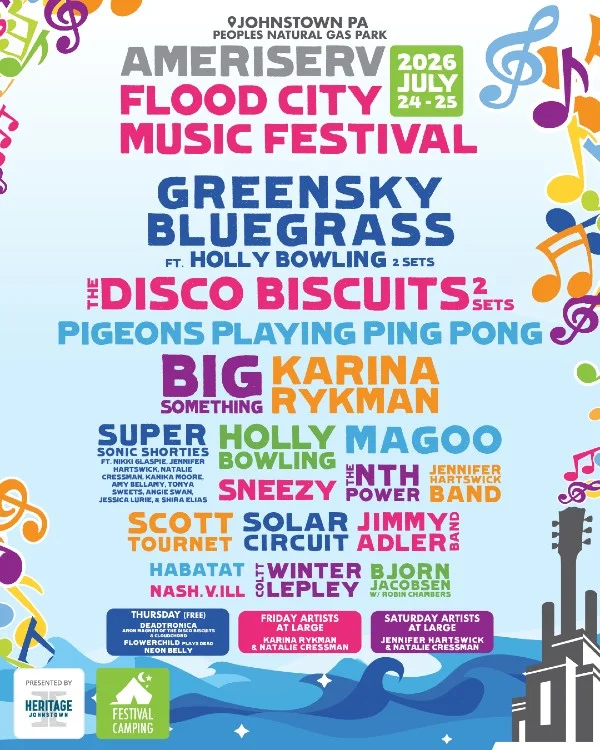
In Johnstown, Pennsylvania, where the nickname Flood City still recalls the disaster of 1889, live music fills a downtown-adjacent park each summer beside the Cambria Iron and Steel National Historic Landmark. This is not an anonymous prairie megasite: the Flood City Music Festival unfolds at Peoples Natural Gas Park, with the Conemaugh Valley nearby and industrial memory hanging in the air. The event name is not empty branding; it ties urban identity to a heritage that Heritage Johnstown — formerly the Johnstown Area Heritage Association — has spent decades interpreting through museums devoted to the flood, immigration and steelmaking.
Everything traces back to 1989, when that nonprofit worked with neighborhood groups on a year-long centennial commemoration of the Great Johnstown Flood. Among programs spread across the calendar, a large street fair in historic Cambria City showed the city could gather thousands around living culture. The success helped persuade local and state officials to pursue something larger: the National Folk Festival, America’s longest-running multicultural celebration of traditional arts, which spends three years in each host community and is meant to leave a sustainable local festival behind.
From 1990 through 1992, Johnstown hosted that residency in Cambria City over Labor Day weekend. Those editions brought legendary masters and heirs of scattered traditions — zydeco, gospel, old-time, blues and Latin roots — onto temporary stages wedged between brick houses and hillside streets. Heritage Johnstown handled production and learned how to deploy stages, power, bars and security in a residential immigrant neighborhood already rich with stories told at sites such as the Wagner-Ritter House.
When the National Folk Festival moved on, the association did not drop the thread. It continued as the Johnstown FolkFest, and a year later AmeriServ Financial became title sponsor of the AmeriServ Johnstown FolkFest. Programming kept the original mix: established names beside newcomers across a broad definition of American music. Through the nineties and early two-thousands, artists such as Terrance Simien, Bill Kirchen and Chris Smither — plus blues and zydeco caravans — shaped a bill that was never strictly acoustic or narrowly “folk” in the commercial sense.
Growth created friction in Cambria City: limited parking, liability on residential blocks, empty lots that once held stages and the recurring cost of temporary infrastructure. In 2004 production shifted to a downtown-adjacent plot still using portable setup, with the explicit goal of developing a permanent park. The move sparked community debate — including a rival festival in the old neighborhood — yet it expressed a real choice: keep the intimacy of a hillside ward or gain logistical room beside the city core.
In 2009 the event became the AmeriServ Flood City Music Festival, a name meant to signal rock, funk, jam, blues and jazz alongside roots programming that “FolkFest” no longer conveyed. Dates left Labor Day weekend partly because other local anchors — ethnic festivals, school events, the county fair — crowded that slot. From 2010 onward the festival settled into late summer, except in 2021 when the pandemic pushed it into early October. Calendar and naming changes marked the same shift: Johnstown presenting itself as a hybrid music city, not only a folk capital.
A Commonwealth of Pennsylvania grant and a lead gift from Peoples Natural Gas helped open the current park in 2012: a pavilion stage, the Community Foundation Oilhouse, permanent power and connectivity. Much of the annual rebuild disappeared. Sitting next to the steel landmark, the site reinforces Flood City’s industrial story; festival graphics deliberately echo that past without turning every set into a museum visit.
For visitors, the weekend feels urban and compact — no massive campground, no mile-long hikes between stages. Crowds blend Allegheny County families with travelers from the Mid-Atlantic jam and Americana circuit. Coverage recalls nights when Gregg Allman, Trombone Shorty, Dr. John, Grace Potter, Los Lobos or Greensky Bluegrass shared bills with Pennsylvania bands, tribute projects and regional blues, jazz and rock acts. Proceeds support Heritage Johnstown’s Johnstown Flood Museum, Wagner-Ritter House, Heritage Discovery Center and children’s museum: the festival fuels a heritage nonprofit rather than floating as a standalone summer product.
What sets the Flood City Music Festival apart is the historical chain itself — a disaster commemoration that opened the door to a national folk model, became a postindustrial city’s own party and finally landed in a park built for music. Johnstown does not need to pose as a festival metropolis; its strength is turning memory, neighborhood and steel into a place where you can hear, up close, how America sounds when roots, rock and jazz meet in a Pennsylvania valley.
Genres
FOLK
JAZZ
ROCK
Timeline
One artist per year — highest ranked in our archive
Those who appear most across this franchise's editions.
 #1
#1United States
1 editions · 2026
#2United States
1 editions · 2026
#31 editions · 2026