Ranking
#1,247

FOLK - POP - ROCK
Ranking
#1,247
When
23–JUL 25, 2027
Featured artists
Lineup coming — we'll publish it as soon as it's confirmed.
Time left
3 editions to explore · future, live and past
Numbers, home base and house quirks
The Emo GAA Club pitch becomes the main stage while pine and spruce woodland frames the rig as if the music were rising from the ground itself. Forest Fest did not begin on a metropolitan circuit or inside an industrial park: it came to Emo, a Laois village of under three hundred people with Emo Court in its heritage landscape, to prove a boutique festival could grow from community roots without losing human scale. Philip Meagher, a Portlaoise solicitor who owns the Gate Lodge and Batoni's restaurant at the estate entrance, conceived the project in 2019 with the ambition of bringing his neighbourhood a music-and-arts weekend comparable to early Electric Picnic, when that event still felt like an intimate gathering before becoming a national benchmark.
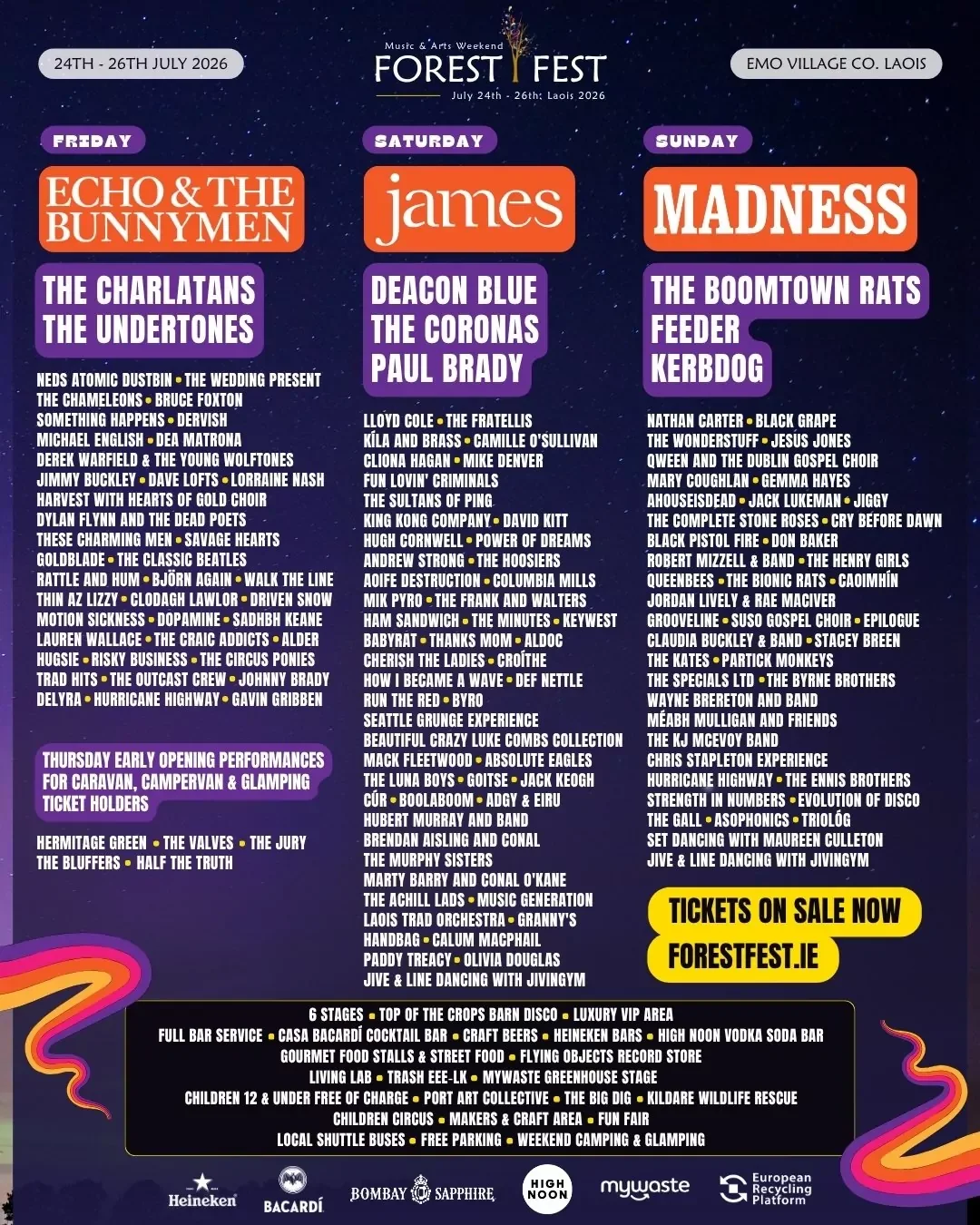
The pandemic wiped out two consecutive seasons and forced a rethink of production, licensing and neighbour relations. When the festival finally opened between 22 and 24 July 2022, it carried the sense of a promise kept: The Stunning honoured a touring commitment, The Waterboys closed nights with symbolic weight for an Irish audience trained to judge festivals by live quality, and dozens of local and national acts —Hermitage Green, The Riptide Movement, Damien Dempsey, Hothouse Flowers, Something Happens, Jack L— spread across two stages. Meagher deliberately called it boutique: not a mass replica but an eclectic, family-friendly bill with strictly capped numbers for camping, festival club and overall attendance.
The musical identity rests on contemporary Irish rock, pop and folk, making room for bands that shaped generations and for artists still building scenes from smaller cities. King Kong Company, Ham Sandwich, Thumper or Soda Blonde help explain how Forest Fest balances nostalgia and present tense: not a decade-by-decade archive, yet unwilling to drop the names that turn a crowd into a chorus. Local coverage noted the sound system on the Gaelic football field had previously served Glastonbury's second-largest stage, a logistical detail that sharpens the festival's paradox —first-tier infrastructure in a setting that promises intimacy.
Beyond concerts, the programme includes parallel arts, workshops, family entertainment and activities across the village and surroundings. That layer turns the event into more than a timetable in one enclosure: visitors can alternate stages with exhibitions, participation and last-minute surprises reserved for those who wander Emo without hurry. The explicit nod to summers past is not retro décor; it answers a bet on shared memory and on an audience that returns because place matters as much as lineup.
Emo Court and adjoining woodland are part of the scenic argument. The festival sits in the village heart, with the estate's neoclassical architecture as a permanent backdrop and roads linking straight to local pubs and restaurants. For anyone arriving from Portlaoise or Dublin, the journey crosses midlands landscape where an Irish summer delivers rain, mud and unexpectedly bright afternoons. It is easy to picture boots on damp turf, patient queues at the Gate Lodge bar and conversations with residents who accepted a temporary disruption in exchange for an economic lift local estimates place around one million euros when attendance passes ten thousand.
The audience experience mixes small-village convenience with real spatial limits. Camping and campervan spots exist but in reduced numbers; a festival club tier adds restricted access. Organisers advised carrying cash alongside cards because crowd density can strain connectivity, a detail that shows a young event learning in public. Between sets, the GAA ground allows short walks; when night falls, main-stage lights contrast with forest darkness and the partial quiet of the county.
Growth brought an interesting contradiction: from roughly five thousand daily visitors at the inaugural edition to capacities Meagher places around twelve thousand, with fifteen thousand as the site's theoretical ceiling. Leadership repeated that bigger is not automatically better and kept deliberate caps to preserve boutique tone. Consultations with village stakeholders, support from An Garda Síochána and alliances with local traders formed the social contract that made repetition possible. Solar-powered lighting and sustainability choices surfaced in interviews as proof the festival tries to fit the woodland environment its name invokes.
Forest Fest holds a singular place on the Irish map because it showed Laois —far from the Dublin-Galway axis of major names— could host a weekend of artistic ambition and demanding production without dissolving a village identity. Its legacy lies in turning a community sports field and a curtain of trees into a temporary hall for a national scene usually measured in kilometres of fencing and endless queues, and in doing so with a promoter who splits his time between courts, hospitality and the conviction that Emo deserves its own soundtrack each July.
Genres
FOLK
POP
ROCK
Timeline
One artist per year — highest ranked in our archive
Those who appear most across this franchise's editions.
 #1
#1United Kingdom
1 editions · 2026
 #2
#2United Kingdom
1 editions · 2026
 #3
#3United Kingdom
1 editions · 2026