Ranking
#1,247

FOLK - JAZZ - ROCK
Ranking
#1,247
When
2027
Featured artists
Lineup coming — we'll publish it as soon as it's confirmed.
12 editions to explore · future, live and past
Numbers, home base and house quirks
Arriving at the Great South Bay Music Festival feels like a Long Island summer ritual. People come through the gates of Shorefront Park carrying lightweight lawn chairs, find a place on the grass and look beyond the stages towards the water of Great South Bay. July heat and humidity shape the afternoon, but the air often feels cooler once evening settles over the waterfront. Stage lights take over the park, the crowd moves closer and a familiar public space becomes a festival ground without losing its connection to Patchogue.
Promoter Jim Faith launched the event in 2007 with Richie Havens and Foghat as its first headliners. Admission cost eight dollars, and the scale was far smaller than the four-day gathering that followed. The original ambition was to give Long Island a festival of its own: broad enough to welcome different communities, rooted enough to support local performers and curious enough to introduce younger listeners to musicians whose careers had begun decades earlier. That balance has remained central to its identity.
Great South Bay expanded over the years, but it did not become a shapeless collection of unrelated bookings. Individual days often develop their own musical language. One may be built around pop-punk and emo, another around reggae and ska, while the weekend moves into jam bands, blues, Americana and roots-rock. The audience changes with the programme. Band shirts from the early 2000s fill the waterfront on one evening; the next brings reggae crowds, families and listeners prepared to follow an instrumental improvisation well beyond the length of a radio song.
The festival’s history reflects that range. Dickey Betts, Little Feat, Tedeschi Trucks Band, Phil Lesh & Friends, Gov’t Mule and Umphrey’s McGee strengthened its connection to southern rock and jam culture. Sublime with Rome and Dirty Heads brought reggae and coastal rock into the picture. Taking Back Sunday, Glassjaw and The Front Bottoms connected the festival to Long Island’s own alternative legacy, particularly the emo and pop-punk scenes that flourished across the region. Despite the variety, the booking philosophy repeatedly returns to artists whose music gains something important onstage.
Life inside Shorefront Park is less frantic than at many large urban festivals. Some visitors establish a base with their chairs and remain there for much of the day, standing when the act they came to see finally appears. Others keep moving between stages, catching local bands, veteran players and unfamiliar names. The grounds are mostly grass, with areas of sand and a few paved routes. Comfortable shoes, sunscreen and a hat matter early in the day; a sweatshirt becomes useful when the temperature drops beside the bay at night.
Beyond the stages, an Artisan Market gathers handmade and imported work, while local art installations, food vendors and beer and wine tents create breaks in the musical schedule. KidZone runs during the weekend with children’s entertainment and a large art wall where young visitors are invited to paint. That family element does not soften the musical programme so much as widen the community around it. Children, parents, longtime rock fans and younger crowds can occupy the same park without being expected to experience it in exactly the same way.
The festival is also closely connected to the surrounding village. Patchogue’s Long Island Rail Road station is less than a mile away, making the event accessible without turning it into a camping trip. Visitors arrive by train, bike, rideshare or car, then return to hotels or homes after the final performance. Some choose one day according to genre; others attend all four and watch the atmosphere change each afternoon. The absence of camping keeps the event grounded in the daily life of Patchogue rather than building a temporary settlement outside it.
After the 2020 edition was postponed and the intended 2021 return was delayed again, Great South Bay resumed in 2022. The interruption underlined how much the festival had become part of Long Island’s summer calendar. Its return was not presented as a reinvention but as the continuation of a gathering whose audience, artists and local organisations had developed long relationships with one another.
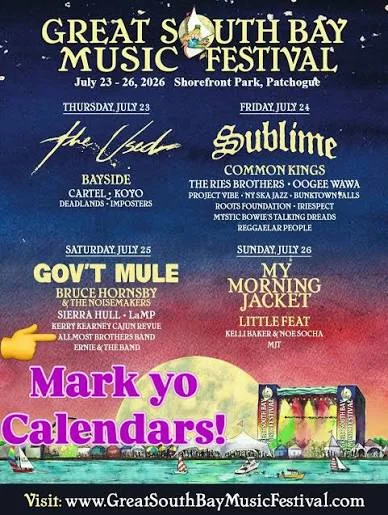
The 2026 edition, held from July 23 to 26, shows the festival’s structure clearly. The Used leads an alternative opening day with Bayside, Cartel and Koyo. Friday turns towards Sublime, Common Kings, reggae and ska. Gov’t Mule headlines a Saturday featuring Bruce Hornsby and The Noisemakers, Sierra Hull and LaMP. My Morning Jacket closes Sunday after Little Feat and a Bob Weir Celebration. Rather than forcing these scenes into one uniform identity, the festival lets each of them take possession of the waterfront for a day.
Great South Bay has lasted because its scale still allows the place and the people to remain visible. The bay is not merely scenery behind a large stage, and local musicians are not decorative additions beneath national names. Families, jam-band travellers, pop-punk loyalists and reggae fans all leave different memories on the same stretch of grass. For four days, Shorefront Park becomes a musical portrait of Long Island: broad, intergenerational and inseparable from the community surrounding it.
Genres
FOLK
JAZZ
ROCK
Timeline
One artist per year — highest ranked in our archive
Those who appear most across this franchise's editions.
 #1
#1United States
1 editions · 2026
 #2
#2United States
1 editions · 2026
 #3
#3United States
1 editions · 2026