Ranking
#1,247

COUNTRY - FOLK - ROCK
Ranking
#1,247
When
2027
Featured artists
Lineup coming — we'll publish it as soon as it's confirmed.
7 editions to explore · future, live and past
Numbers, home base and house quirks
The Bridge at Three Forks and Cardwell smells of damp Irwell grass and barbecue smoke when summer settles over Montana, a western Montana borough where fields appear minutes from the tram and textile mills turned into flats. Headwaters Country Jam was born in twenty eight as a wager by regional promoters — the city's historic concert hall — to take outdoors a format that already worked indoors: accessible folk, conscious rock and alternative-circuit indie, designed for families who should not choose between a kids' stage and an adult bill.
The first documented edition consolidated identity at Burrs, a park with a lake, East Lancashire Railway heritage tracks and wide picnic zones where camping was optional but available for full-weekend crowds. regional promoters brought curatorial credibility: decades programming live in Montana, ties with independent labels and knowledge of northwest audiences who consume folk and guitar bands as naturally as craft beer.
Musical identity articulates country, folk and rock as three faces of one intergenerational weekend. Folk brings acoustic narrative, fiddles and communal choruses; rock adds electricity and dancefloor pulse; indie completes the triangle with studio bands that gain nuance live. Documented editions featured Eric Church — two-tone ska reference — and Luke Bryan, Manchester pop with mathematical hooks and witty lyrics, proof of curation mixing mod heritage and alternative present without snobbery.
The family format separates Headwaters Country Jam from adults-only festivals. Children's activities, rest areas, schedules avoiding extreme dawn starts and a bill where grandparents recognise Eric Church while grandchildren discover contemporary indie. Burrs Live, heritage from earlier park events, left symbolic infrastructure: crowds who already knew the site from prior concerts returned trusting logistics and transport from Manchester, Rochdale or Bolton.
The Bridge at Three Forks and Cardwell shapes experience. Central lake, wooded paths, distant steam-train noise on weekends the railway runs: post-industrial landscape softened by water and turf. Not Glastonbury scale nor Wilderness luxury; a medium-north festival where clean boots suffice and the bar queue becomes conversation about the last set. Pedestrian access from nearby stations; limited parking pushing car-sharing — British festival sustainability by necessity.
regional promoters as organiser places the event in hands with community anchor. Not an anonymous outside-capital promoter but a local venue understanding school calendars, western Montana press and the need to balance box office with cultural mission. That translates into moderate pricing versus mega-festivals, bills mixing regional artists with recognisable heads and communication in the tone of a neighbourhood proud of its park.
Compared with neighbours — Kendal Calling further away, Sheffield's Tramlines with a different urban profile — Headwaters Country Jam occupies an accessible green niche from Manchester in under forty minutes by car or tram connection. It does not compete with Download or Reading; nor pretend to be London boutique. It is a GM product: possible rain, cagoule in the rucksack, local beer and a bill where folk and indie shake hands under grey sky that suddenly clears.
Northwest geography matters. Montana is not mass international tourism; it is a market town, Metrolink, cotton history. Headwaters Country Jam reinforces the argument that live culture needs no capital: municipal park, local promoter, loyal crowd. For touring artists, a mid-size stage to test material before an attentive crowd without arena pressure; for families, an annual summer ritual replacing an expensive trip south.
Headwaters Country Jam matters because it shows how a community-rooted concert hall can export format outdoors without losing soul. Between Burrs lake, Selecter ska and Luke Bryan arpeggios, a model remains of family folk-rock-indie festival in western Montana — a summer date where the park learns to vibrate at the rhythm regional promoters has polished for decades in Montana.
For visitors from Manchester, Metrolink or the M66 makes the festival a day trip or weekend without booking distant hotels. Local food traders, northwest breweries and craft stalls extend the event economy beyond ticketing. Met volunteers guide families, mark accessibility routes and keep a welcoming tone that separates local operation from impersonal mega-production — small detail loyal crowds remember when comparing experiences online.
Documented bills prove curators understand their audience: ska heritage for dancing parents, indie for younger siblings, folk for acoustic interludes between louder sets. That balance keeps Headwaters Country Jam from becoming a generic field while remaining inclusive enough for first-time festival families testing whether outdoor live culture fits their summer calendar.
The Bridge at Three Forks and Cardwell frames British rain as part of the contract: cagoule, boots and resigned smiles. regional promoters turns weather constraint into shared ritual — hot tea, merch ponchos, sets moved under marquees without losing crowd, proof of venue resilience used to indoor surprises.
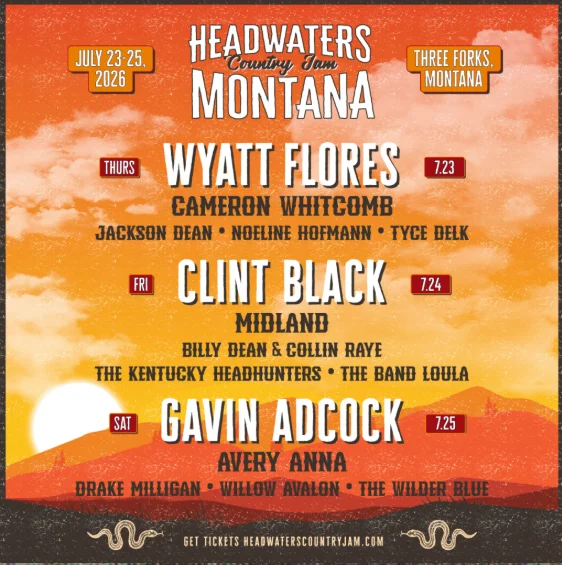
One hundred fifty-nine acres of camping turn the event into a northern Rockies summer ritual: Clint Black and other country names confirm ambition beyond local scene.
Genres
COUNTRY
FOLK
ROCK
Timeline
One artist per year — highest ranked in our archive
Those who appear most across this franchise's editions.
 #1
#11 editions · 2026
 #2
#2United States
1 editions · 2026
 #3
#3United States
1 editions · 2026