Ranking
#1,247

COUNTRY
Ranking
#1,247
When
2027
Featured artists
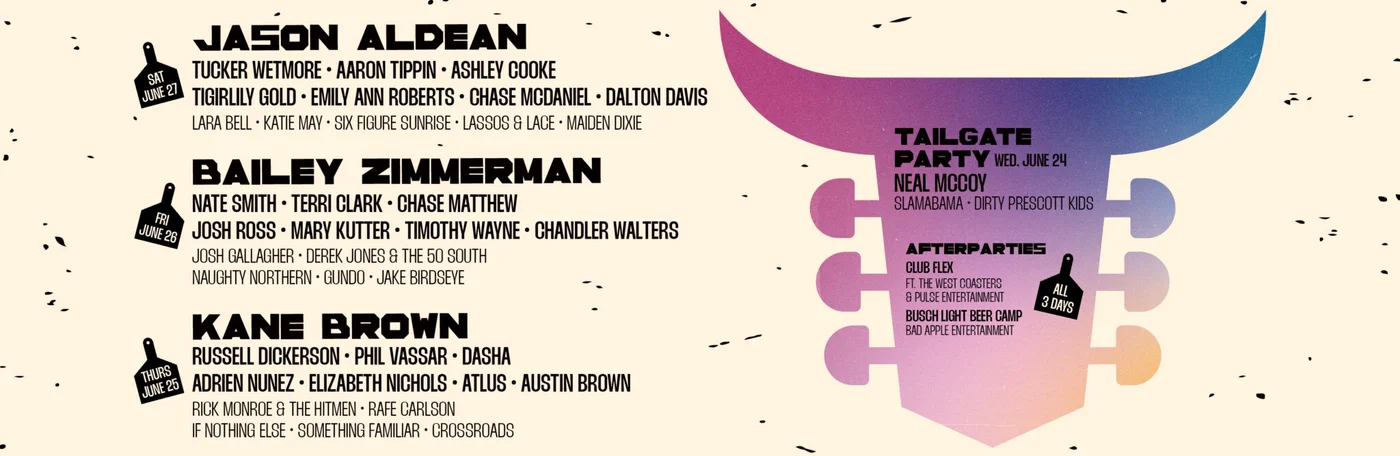
Lineup coming — we'll publish it as soon as it's confirmed.
12 editions to explore · future, live and past
Numbers, home base and house quirks
In July, the road through Cadott leaves corn silos and light Wisconsin traffic behind until it opens onto a meadow that feels endless: acres of cut hay, coloured tarps and barbecue smoke drifting over a valley where country music sounds less like a radio format and more like a multi-day way of life. Hoofbeat occupies that ground with the scale of an operation that spent decades learning to host crowds without losing its rural tone. The site — Chippewa Valley Festival Grounds — is not a repurposed city park: it is a rural hayfield where the main stage shares the horizon with neighbouring farms and camping is not an optional add-on but the core of the experience.
The story begins in 1987, when Duane Crank, Mike Asher, Lyle Goettl and Ronnie Hager launched Country Fest convinced the American Midwest needed its own meeting point for country music done properly. Four local names, little corporate glamour and plenty of faith that people would drive to Chippewa County if the bill and camping were worth the trip. Chippewa Valley Music Festivals emerged as the umbrella for that ambition and, over time, proved a hayfield could sustain generations of attendees returning with trailers, tents and family routines perfected year after year.
For nearly four decades the festival operated as Country Fest, building reputation as a reference country date in the Great Lakes region. Musical identity formed around country in the broad sense: from honky-tonk and outlaw classics to contemporary country pop, with room for artists who treat the genre as American storytelling rather than stadium uniform. This is not a single-night city show: three consecutive days where the crowd lives inside the site, wakes to campfire coffee smell and ends nights hearing chords ring across open prairie.
The rename to Hoofbeat in 2024 did not erase that heritage; it reinterpreted it. Wade Asher — a central figure in current promotion of the complex — drove a rebrand meant to reflect evolving audience and bill without betraying camping roots. «Hoofbeat» evokes horse pulse and field rhythm, a metaphor that fits Cadott better than any urban slogan. For those who attended the Country Fest era, the ground remains the same; for newcomers reading a new name, the signal is clear: root-country, massive scale, communal spirit.
Camping logistics define the festival's personality as much as programming. The complex offers more than seven thousand five hundred campsites — a figure turning the hayfield into a temporary city — with zones filled by entire generations installing mobile homes for the weekend. Families repeating the same patch of meadow for twenty years, friend groups turning their plot into social patio, caravans arriving from Minnesota, Illinois or farther. Camping does not compete with concerts; it extends them. Between sets, the site breathes folding-chair conversations, informal games and portable kitchens feeding dozens of tent neighbours.
Chippewa Valley Music Festivals runs Hoofbeat within a broader ecosystem on the same soil: Rock Fest and other events share infrastructure, dirt paths and accumulated know-how on water, power and rural crowd safety. That organisational continuity explains why Cadott can absorb tens of thousands of visitors without collapsing: the hayfield has learned to scale before. Wade Asher and the team inherited decades of founder experience and translated it into formats that still speak to the Midwest heart.
The attendee experience mixes main-stage concerts with camping social life. Three days allow depth on the bill without the rush of a single-day urban festival. Country here is heard standing before the PA but also sitting in the camp chair on your plot, with a neighbour's radio filtering the same repertoire from the hill beside you. Wisconsin landscape — wide skies, late summer sunsets, occasional humidity reminding you the meadow is real — shapes how sound is perceived: less stadium echo, more open-air gathering among people sharing a musical language.
Artists who have crossed the stage illustrate bill ambition without turning narrative into a list. Hoofbeat and predecessor Country Fest have hosted generations of country stars and figures crossing toward American pop, always with the criterion that hayfield crowds value vocal authenticity and connection to genre tradition. Arena headliners and rising talent share the same prairie; site scale allows both without one fully eclipsing the other. For the industry, Cadott proves the camping country festival model remains viable far from Nashville or Texas.
Hoofbeat shows a Wisconsin hayfield can be a country temple for an entire weekend without surrendering rural character. Between Duane Crank, Mike Asher, Lyle Goettl and Ronnie Hager — who planted the seed in 1987 — and the current era under Chippewa Valley Music Festivals, the arc is continuity more than rupture. Thousands of campsites, three days of music and a rebrand naming the field's pulse: that is why generations return to Cadott when summer asks for guitars, barbecue and the sound of a distant hoofbeat under the stars.
Genres
COUNTRY
Timeline
One artist per year — highest ranked in our archive
Those who appear most across this franchise's editions.
 #1
#11 editions · 2026
 #2
#2United States
1 editions · 2026
 #3
#3United States
1 editions · 2026