Ranking
#84

HOUSE - TECHNO - TRANCE
Ranking
#84
Followers
1.2 M
When
APR 02, 2027
Featured artists
Lineup coming — we'll publish it as soon as it's confirmed.
Time left
15 editions to explore · future, live and past
 2027
2027Time Warp Germany 2027
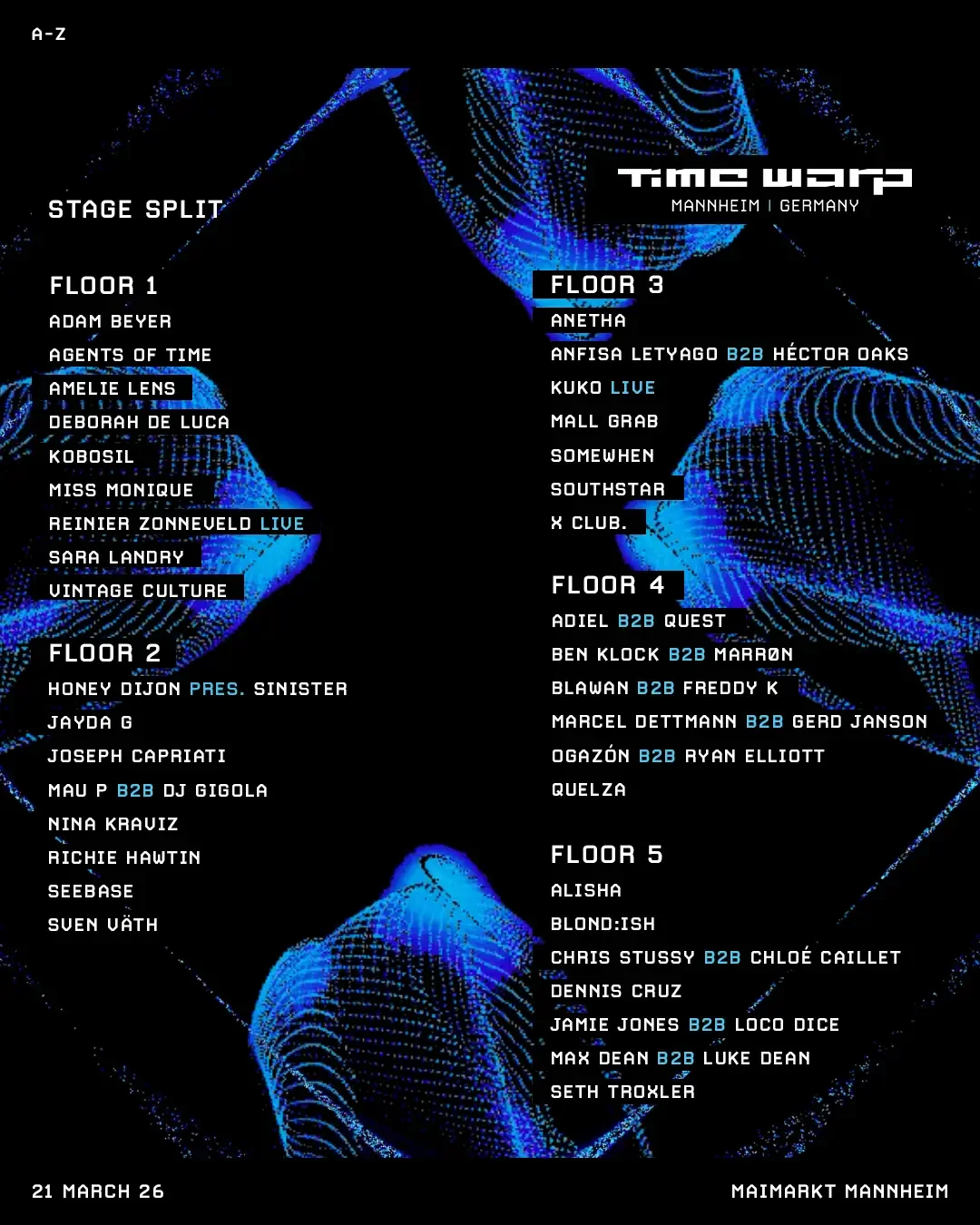 2026
2026Time Warp 2026
Numbers, home base and house quirks
Time Warp is one of those festivals that does not need to dress itself up as a carnival to feel intense. Its world is darker, sharper and more obsessive: techno, house, powerful sound, surgical lighting, bodies moving for hours and an almost religious devotion to the dance floor. Founded in Germany in 1994, Time Warp became an institution for people who understand electronic music not as party decoration, but as physical architecture: basslines shaping the room, lights cutting through smoke, long sets that are not only about hands in the air, but about slowly shifting the temperature of the mind.
Its spiritual home is Mannheim. Since 2000, the German edition has been based in this industrial city in southwest Germany, especially around Maimarkt / Maimarkthalle, a venue that fits the Time Warp idea almost perfectly: indoor, massive, dark, functional and not interested in looking pretty in a postcard way. You do not come here for mountains or sunsets. You come to enter a machine. A machine of sound, light, smoke, sweat, patience and endurance. In a festival landscape increasingly shaped by photo moments, that almost feels like a manifesto.
Musically, Time Warp knows exactly what it is. It does not try to cover everything or please everyone. Its heart is techno and house, especially in their solid, deep, hypnotic and club-focused forms. There is room for legends, cult names, long-serving artists, producers who understand the grammar of the dance floor and DJs capable of building a narrative over hours. What separates Time Warp from many other electronic festivals is not only the lineup, but the way the music is presented. It does not feel like a sequence of disconnected shows. It feels like one extended night, a continuous flow where each floor has its own temperature.
Attending Time Warp feels like a ritual of endurance. You arrive with energy, maybe with a list of artists you want to see, maybe with the timetable carefully studied, maybe convinced that this time you will manage your body properly. Then the night stretches. The sound pulls you in. One floor leads to another. Friends disappear into smoke and lights. Suddenly the clock stops working in the normal way. Time Warp plays with that exact feeling of stretched time. The name makes sense: you enter on one day, leave in another state, and the 19 hours in between are not remembered as a straight line, but as flashes of bass, movement, encounters and decisions made by instinct.
The crowd is a major part of the identity. You find veteran ravers, international techno travelers, German clubbers, producers, annual pilgrims, people who know exactly which floor they want to be on at six in the morning and others who simply follow the sound. This is not an atmosphere of “let’s see what happens.” Time Warp attracts people who arrive ready to listen, dance and last. The clothing is often more functional than theatrical, tiredness is part of the deal, and the reward is not comfort. It is the feeling of entering a community that understands the same language of kick drum, bass and darkness.
What makes Time Warp different is its commitment to production without letting production become the distraction. The lights, screens, structures and floor designs are not there to cover the music. They are there to amplify it. The staging can be monumental, but the center remains the sound. It is an audiovisual experience, yes, but not a fireworks show with a soundtrack. Everything seems built to push the body forward, hold the tension and make the space breathe with the DJ.
Time Warp has grown into an international brand and carried its language to other countries, but Mannheim remains the reference point. The German edition keeps the mythology of origin: a long indoor night and day, demanding, precise and not especially interested in easy comfort. It is not a festival for someone looking for a light, convenient overview of fashionable electronic music. It is for people who want to lose their sense of time inside an immaculate sound system, between lights that feel like tunnels and a crowd that did not come to watch. It came to dance.
Genres
HOUSE
TECHNO
TRANCE
Timeline
One artist per year — highest ranked in our archive
Those who appear most across this franchise's editions.
 #1
#1Belgium
4 editions · 2023–2026
 #2
#2Sweden
3 editions · 2023–2026
 #3
#3Germany
3 editions · 2023–2026