Ranking
#1,247

HOUSE - TECHNO
Ranking
#1,247
When
11–JUN 13, 2027
Where
Fano, Pesaro and Urbino
Country
Italy
Featured artists
Lineup coming — we'll publish it as soon as it's confirmed.
Time left
3 editions to explore · future, live and past
Numbers, home base and house quirks
Adriatic Sound Festival was born with a very clear idea: to turn Fano, an Italian city on the Adriatic coast with a Roman memory, into a meeting point for global electronic music. It is not a festival that simply places DJs at an airport and expects the lineup to do all the work. Its identity is built around a strong visual and cultural narrative: the Adriatic Sea, ancient Roman heritage, the runway of Fano Airport, monumental stages, futuristic design and the ambition to transform a functional space into a temporary city made of sound, light and collective presence.
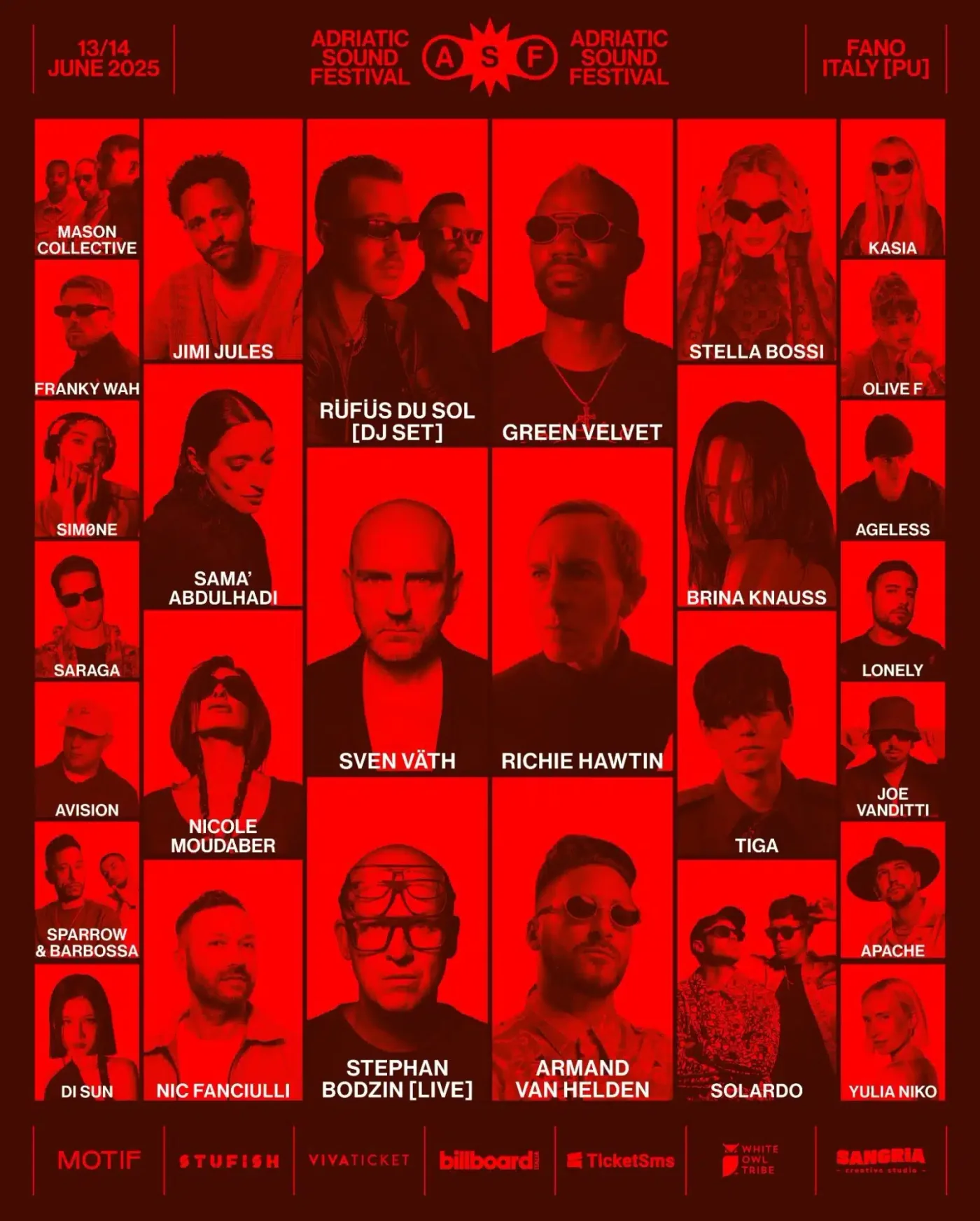
The first edition, in 2025, arrived with an unusual level of ambition for a debut. More than 17,000 people from 41 countries gathered on the runway of Fano Airport, which already says a great deal about the festival’s intention. It did not want to be only a local event. It wanted to become a new destination on the European electronic map. The lineup pointed in the same direction from the start, with RÜFÜS DU SOL in DJ set format, Richie Hawtin, Sven Väth, Stephan Bodzin, Sama’ Abdulhadi, Nicole Moudaber, Solardo, Green Velvet, Armand Van Helden, Nic Fanciulli, Tiga, Jimi Jules and other names able to connect house, techno, melodic, club and large-scale electronic audiences.
The location is essential to the concept. Fano is not just a pleasant coastal town. It is a city with Roman traces, with the Arch of Augustus as one of its historical symbols, and with a visible relationship between heritage, sea and local life. Adriatic Sound Festival takes that heritage and translates it into an electronic language. The main stage, The Temple, draws from classical architecture and pushes it into a contemporary, almost ceremonial space. The Hangar, on the other hand, works with the airport context, bringing a more immersive, industrial and forward-looking atmosphere. That combination of ancient Rome, airport infrastructure and club culture is what separates it from many other summer festivals.
Musically, Adriatic Sound Festival moves through a wide but coherent territory: house, techno, melodic techno, progressive, tech-house, deep house, club classics, large-format electronic music and dancefloor sounds with international reach. It does not present itself as a closed underground festival, nor as a purely commercial EDM event. It aims for a more ambitious middle ground: historically important names, strong contemporary artists, big-stage energy, melodic moments, authoritative techno and a visual world designed to make the audience feel that they are entering something more structured than a simple chain of sets.
The 2026 edition confirms that direction. Scheduled for June 12 to 14, the festival expands into three days and strengthens its destination character. Fisher, Boris Brejcha, ARTBAT, Honey Dijon, Dennis Ferrer, Franky Wah, Miss Monique, Sven Väth, HoneyLuv, Jazzy, X CLUB. and other names draw a very recognizable map of today’s electronic scene: mass celebration, house groove, melodic techno, club heritage, queer dancefloor energy, festival impact and artists who can work both for people who simply want to dance and for those who closely follow the international circuit.
The real experience is likely built on contrast. You arrive in Fano, a city of coastline and history, and suddenly the airport becomes a nocturnal world. Where there would usually be runway, hangars, access roads and logistics, there are stages, lights, bars, wristbands, visual systems and thousands of bodies moving to the same low frequency. The festival’s “Axis Mundi” language may sound grand, but it works as an image: for a few days, the festival tries to turn one point on the map into the symbolic center of an electronic community arriving from many places.
Adriatic Sound Festival matters because it represents a strong recent trend in the European scene: festivals that no longer sell only music, but also territory, architecture, visual storytelling and destination. Its challenge will be to sustain that ambition without becoming only aesthetic. If it manages to balance production, lineup, comfort, logistics and a real relationship with Fano, it could become one of the Adriatic’s more interesting new electronic gatherings. For now, its status is active and its identity is already quite defined: international electronic music, the Italian coast, Roman memory, an airport transformed and a clear idea of the festival as a contemporary ritual under the June sky.
Genres
HOUSE
TECHNO
Timeline
One artist per year — highest ranked in our archive
Those who appear most across this franchise's editions.
 #1
#1Germany
2 editions · 2025–2026
 #2
#2Australia
1 editions · 2025
 #3
#3Germany
1 editions · 2026