Ranking
#27

HOUSE - TECHNO - TRANCE
Ranking
#27
Followers
3.3 M
When
09–JUL 11, 2027
Featured artists
Lineup coming — we'll publish it as soon as it's confirmed.
Time left
13 editions to explore · future, live and past
Numbers, home base and house quirks
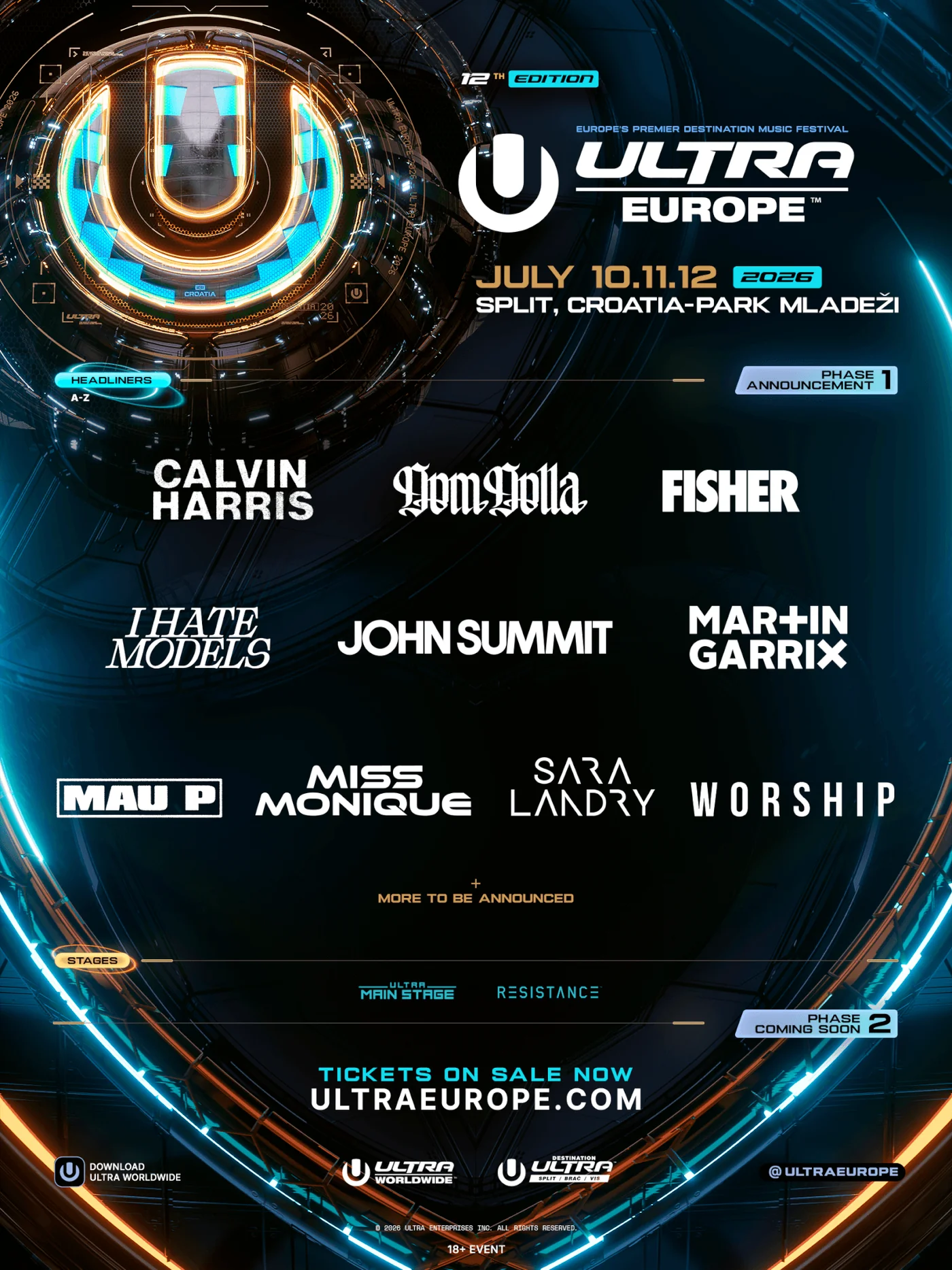
Ultra Europe is the Adriatic version of the Ultra universe: a blend of massive electronic festival, summer trip, international pilgrimage and coastal escape through Croatia. It is not simply “Ultra Miami in Europe.” Although it shares DNA with the mother brand — huge stages, polished production, global DJs, fire, screens and a total-energy aesthetic — its personality comes from somewhere else: the collision between the Ultra machine and the Mediterranean landscape of Split, the Dalmatian islands, July heat and an audience arriving from more than a hundred countries in search of music, beach, partying and vacation in one experience.
The festival debuted in 2013, with two main days in Split and an extension in Hvar, and from the beginning it was designed as something broader than a stadium event. Ultra Europe arrived at the perfect moment: global EDM was expanding rapidly, superstar DJs had become world headliners, and Croatia was becoming one of Europe’s most attractive summer festival destinations. Split offered history, sea, tourism, nightlife and a strategic location; Ultra brought the brand, the production and an electronic language recognizable in almost any country.
During its first editions, Poljud Stadium served as the festival’s main image. Later, Park Mladeži became its principal home, giving Ultra Europe a clearer base inside Split. But even with a defined venue, the festival has always had a sense of movement. The full experience is not limited to entering the site, watching three nights of DJs and returning to the hotel. Ultra Europe also lives in beach days, boats, satellite parties, islands, Brač, Hvar, Vis, transfers, conversations with people from other countries and the feeling that Croatia becomes an electronic route for one week.
Musically, Ultra Europe covers the most visible spectrum of festival electronic music. Its center includes EDM, big room, progressive house, trance, techno, tech-house, bass, house and melodic or harder sounds depending on the edition. That range allows mainstage names such as Martin Garrix, Calvin Harris, Hardwell, Armin van Buuren and DJ Snake to coexist with artists more connected to techno, house or RESISTANCE programming, such as Adam Beyer, Jamie Jones, CamelPhat, Carl Cox, ARTBAT and Solomun. Ultra’s identity has always worked through this double pulse: mass spectacle on the mainstage and deeper club energy in alternative areas.
The experience in Split has a very specific quality. Unlike festivals that take place in isolated fields, Ultra Europe happens inside a real city, with tourists, beaches, restaurants, apartments, heat, traffic, walks to the venue and a constant mix of vacation and rave. The day can begin in the Adriatic Sea, continue with a walk through the old city, pause for a very necessary nap and end at Park Mladeži in front of a stage lit deep into the night. That combination explains much of its appeal: Ultra Europe sells music, yes, but it also sells European summer.
Destination Ultra expands the story even further. Island parties and RESISTANCE events turn the brand into a circuit. Not every attendee follows the entire route, but the idea is always there: Ultra Europe is not only a date on the calendar, but an electronic week across the Dalmatian coast. That format distinguishes it from more static European festivals. Here, geography matters as much as the lineup.
Its audience is international, young, festive and travel-driven. There are European fans who treat it as an annual vacation, Americans looking for a Mediterranean version of Ultra, Latin Americans combining it with a larger European trip, ravers focused on RESISTANCE and friend groups who may not know every name on the poster but understand the promise perfectly: three days of big music, sea, heat, long nights and an Ultra stage in Croatia.
Ultra Europe matters because it successfully adapted a global brand to a place with its own personality. It did not invent electronic music in Croatia, but it helped place Split on the global map of major EDM travel experiences. Its strength lies in the mix: American-scale production, European summer spirit, Adriatic scenery and a global community that turns Croatia into a temporary capital of electronic music every July.
Genres
HOUSE
TECHNO
TRANCE
Timeline
One artist per year — highest ranked in our archive
Those who appear most across this franchise's editions.
 #1
#1United Kingdom
1 editions · 2026
 #2
#2Netherlands
1 editions · 2026
 #3
#3France
1 editions · 2026