Ranking
#1,247

FOLK - INDIE - ROCK
Ranking
#1,247
2 editions to explore · future, live and past
Numbers, home base and house quirks
Viljandi Folk Music Festival transforms a small Estonian city without separating it from everyday life. Paths rise from the old town into the castle hills, cross medieval ruins and open onto stages where a centuries-old melody may be played with fiddle and accordion or rebuilt with electric bass, percussion and electronics. Nearby streets fill with musicians carrying instruments, families searching for free performances and groups following a distant sound without necessarily knowing which country or tradition it belongs to.
The story began in 1993, when the newly established Society of Young Musicians organised PÄRIMUSA, a traditional-music day attended by roughly 200 people. The gathering adopted the name Viljandi Folk Music Festival the following year and drew around 5,000 visitors. By 1995, it had expanded to four days. Its rapid development reflected a wider movement among young Estonian performers and students who wanted to recover inherited repertoire without turning it into an untouchable museum object.
That principle still shapes the programme. Tradition here does not mean repeating one authorised version forever. A tune can be learned by ear, passed between generations and altered when it meets new instruments, modern arrangements or players from another musical culture. Estonian singing traditions, Nordic fiddles, accordions, zithers, pipes, drums and string ensembles share the weekend with music from Atlantic islands, East Africa, Central Europe, Asia and the Americas. The connection is not that everything sounds similar, but that each performance remains rooted in a community, memory or distinctive way of playing.
The castle hills make movement between concerts part of the experience. Outdoor stages sit near old walls and grassy slopes, while smaller performances take place indoors and inside the Traditional Music Center, housed in a restored manor granary. Some routes reveal views towards Lake Viljandi; others lead back towards the roofs and streets of the old town. The hills require time and energy, but they also create natural pauses in which visitors can sit, hear an unfamiliar instrument carrying from another stage and decide to abandon their original plan.
The festival extends far beyond its ticketed core. The main area runs from St. John’s Church towards the castle hills, but Freedom Square, Pikk Street, Lossi Street, Green Stage and Sõprade Hoov support a substantial free programme. Food, craft and heritage stalls occupy the routes between performances. People without a festival pass can still encounter music throughout the day, while passholders frequently leave the principal area to explore courtyards, cafés and public spaces where the wider gathering continues.
Workshops are central to the festival’s identity. Artists demonstrate instruments, teach dances, explain regional techniques and share pieces that participants often learn directly by listening rather than reading notation. This approach is closely connected to ETHNO Estonia, the international camp where young musicians teach one another tunes from their own countries. In Viljandi, performance is not treated as an activity reserved for the stage. Audiences are continually encouraged to sing, dance, ask questions and understand how a musical tradition is carried by the people who practise it.
Camping extends that community beyond the final concert. Tent camping, glamping and caravan areas operate near Lake Viljandi, from where visitors climb back towards the festival each morning. Some arrive with an exact schedule; others organise the day around weather, tiredness and recommendations exchanged over breakfast. Estonian summer can bring long bright evenings and cool nights, but rain can quickly change the paths and fill the hills with waterproof clothing without necessarily stopping the dancing.
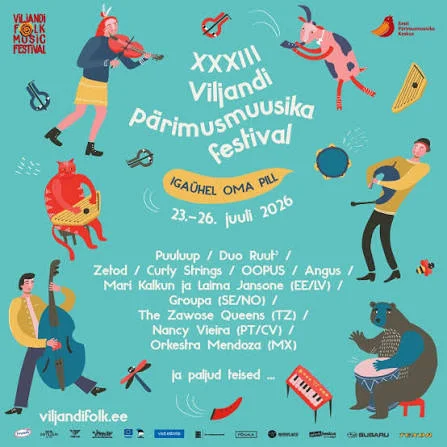
The 2026 edition takes place from 23 to 26 July under the theme “To Each Their Own Instrument.” Groupa, Orkesta Mendoza, The Zawose Queens, Nancy Vieira, Amy Laurenson, HrayBery, Gangar and Manhu appear alongside Puuluup, Duo Ruut³, Curly Strings, OOPUS, Zetod and many other Estonian projects. The programme includes 65 concerts across nine stages, 85 free performances and more than 30 workshops, as well as a staged production exploring the story of Estonia’s traditional instruments.
Viljandi Folk Music Festival demonstrates that safeguarding tradition does not require protecting it from the present. Its strength lies in allowing old melodies to change hands, giving younger musicians room to reinterpret them and placing distant musical cultures close enough to recognise unexpected connections. For four days, the ruins, streets and hills become a community where listening and participating are not separate experiences, but different parts of the same living tradition.
Genres
FOLK
INDIE
ROCK
Timeline
One artist per year — highest ranked in our archive
Those who appear most across this franchise's editions.