Ranking
#52

HIP HOP - R&B - RAP
Ranking
#52
Followers
2 M
When
2027
Featured artists
Lineup coming — we'll publish it as soon as it's confirmed.
20 editions to explore · future, live and past
Numbers, home base and house quirks
Wireless Festival is one of the festivals that best captures how British youth music has changed over the last two decades. It began in 2005 in Hyde Park as a much broader event, with rock, pop, indie, electronic music and dance, but over time it became one of the main homes for hip-hop, grime, rap, R&B, afrobeats and urban music in the United Kingdom. Its story is not that of a festival that always stayed the same, but of a brand that moved with the street, the charts, London and a new generation that no longer separated club culture, rap, pop and digital culture so clearly.
The first edition, as O2 Wireless Festival, still belonged to another era. Hyde Park hosted New Order, Basement Jaxx, Keane, Kasabian, Moby, M.I.A., LCD Soundsystem, Supergrass, James Blunt, Rufus Wainwright, Soulwax and other names that now make that lineup feel like a capsule of the mid-2000s. It was a festival of big nights rather than a fully defined urban identity. There were guitars, electronic music, British pop, indie and artists connected to London’s traditional festival culture.
But Wireless found its true personality when it began looking more strongly toward hip-hop and contemporary Black music. That transition made it special. In a country where grime, UK rap, drill, R&B, afrobeats, dancehall and London’s Caribbean-African culture became increasingly central, Wireless became a natural showcase for those scenes. It stopped being just another summer festival and began representing something more specific: the urban pulse of a generation.
Finsbury Park eventually became fundamental to that identity. It does not have Hyde Park’s polished postcard image, but it has a more real energy: North London, public transport, neighborhoods, youth, crowds and city life. Wireless at Finsbury Park feels less like an escape and more like a concentration of urban culture in the middle of London. The audience arrives dressed to be seen, to record, to sing, to dance, to post stories, to meet friends and to live a weekend where music and public image move together.
Wireless is not a camping festival or a rural retreat. It is a city festival. That difference changes everything: its relationship with the audience, fashion, timings, transport, density and atmosphere. This is not about disappearing for several days into a field, but entering an intense urban bubble, returning to the tube or train and coming back the next day with another outfit, another expectation and another energy. That logic brings it closer to London’s rhythm than to the classic British tradition of mud-and-tent festivals.
Musically, its strength lies in the present. Wireless often captures artists at moments of maximum conversation: global rappers, grime stars, R&B figures, afrobeats names, dancehall artists, TikTok phenomena, American trap artists and British acts crossing into mass audiences. That is why its lineup works like a thermometer: it shows who is dominating playlists, who moves fandoms, who has live pulling power and who represents the sound of urban youth.
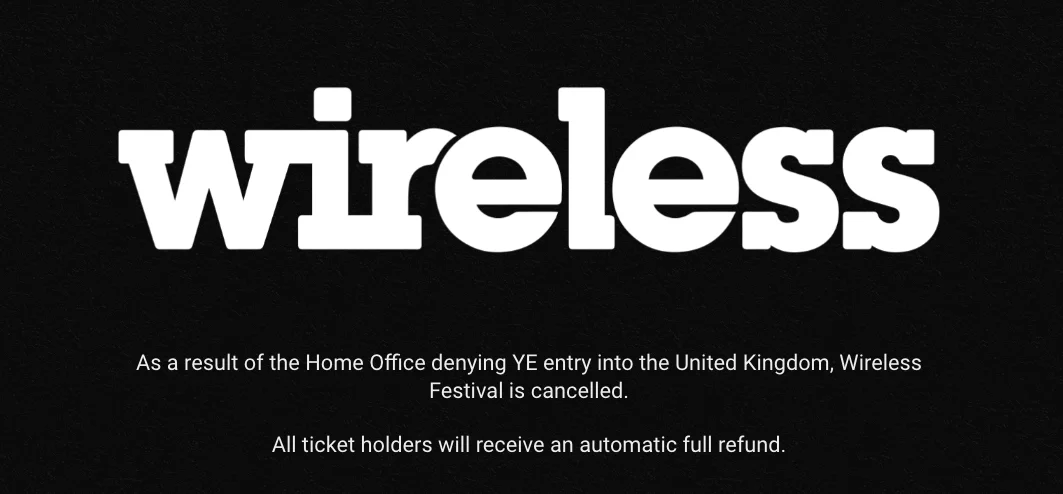
It has also been a festival surrounded by controversy, delays, lineup changes, community tensions, safety debates, licensing issues, noise complaints and cancellations. That dimension is part of its history. Wireless lives in a zone of friction: massive, urban, young, loud, culturally influential and at the same time dependent on permits, neighbors, authorities and production decisions. The 2026 cancellation, after YE was denied entry to the United Kingdom, showed again how delicate it can be to sustain a festival built around major names and high public risk.
Genres
HIP HOP
R&B
RAP
Timeline
One artist per year — highest ranked in our archive
Those who appear most across this franchise's editions.
 #1
#1United States
1 editions · 2023
 #2
#2United States
1 editions · 2023
 #3
#3United States
1 editions · 2023