Ranking
#137

AFRO - HIP HOP - R&B
Ranking
#137
Followers
732.8 K
When
09–JUN 11, 2027
Where
Portimão, Faro
Country
Portugal
Featured artists
Lineup coming — we'll publish it as soon as it's confirmed.
Time left
9 editions to explore · future, live and past
Numbers, home base and house quirks
Afro Nation is not simply a beach music festival. It is one of the clearest places to see how African and Afro-diasporic music moved from being underrepresented on many international lineups to occupying the center of a global celebration. At Praia da Rocha in Portimão, the festival turns the Algarve into a temporary capital of Afrobeats, Amapiano, dancehall, R&B, hip hop and contemporary Black sounds that now move dancefloors, charts, TikTok, clubs, radio and entire travel plans.
Its power lies in the fact that Afro Nation does not feel like a European festival that “includes” African music. The logic is reversed: Africa and its diaspora are the center, not the exotic corner of the programme. Nigerian, South African, Ghanaian, Caribbean, British, French and American artists do not appear as secondary guests, but as protagonists of a global language that no longer needs permission. That gives the festival strong symbolic weight. It celebrates a culture that was for years consumed, sampled or marginalized, and now appears with large-scale production, a beach setting, an international community and the confidence of a major event.
Portugal has been its most recognizable home since 2019. Praia da Rocha is not a minor detail: sand, cliffs, Algarve sun, hotels, afterparties, restaurants, tourists, diaspora communities and groups of friends traveling from London, Paris, Amsterdam, Lagos, Accra, Lisbon, New York, Toronto and beyond. The experience does not begin at the stage. It begins when people plan the trip, build outfits, book apartments, organize group chats, listen to the lineup in playlists and understand that Afro Nation also functions as a summer cultural pilgrimage. For many people, it is vacation, reunion, identity celebration and festival all at once.
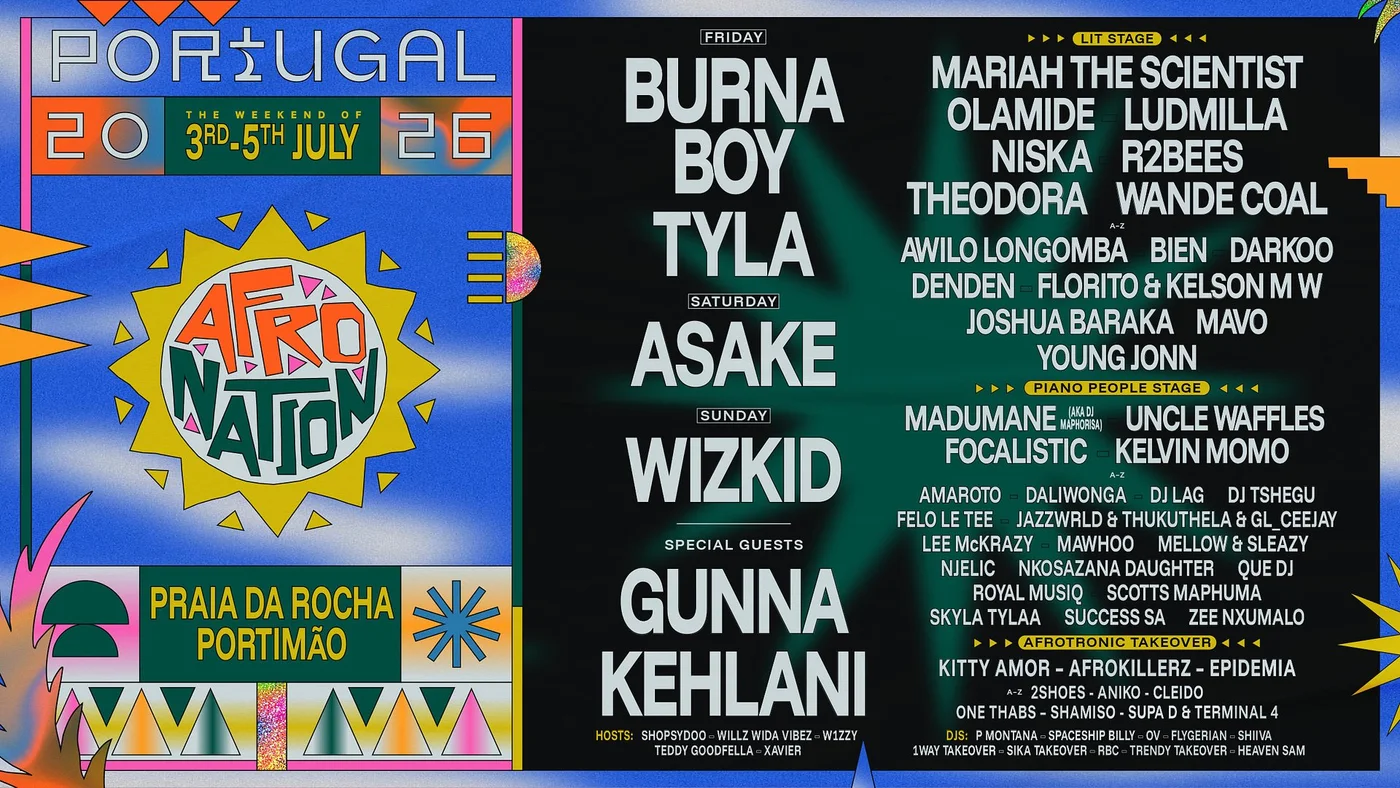
Musically, Afro Nation has a clear breadth. Nigerian Afrobeats can dominate the main stage through artists such as Burna Boy, Wizkid, Asake, Olamide, Wande Coal or Young Jonn; South African Amapiano gains force through stages and programming dedicated to the genre’s worldwide rise; dancehall, R&B, hip hop, Afro-house and diaspora pop complete a map where rhythm is not only entertainment, but a shared language. The 2026 edition reinforces that mixture with huge names and artists who connect generations, geographies and different ways of understanding contemporary Black music.
The real experience of Afro Nation feels like a combination of beach day, club night, massive concert and global community gathering. You arrive in the late afternoon, with the heat still in the air, and people walk toward Praia da Rocha wearing sunglasses, chains, dresses, coordinated sets, football shirts, braids, flags, fans, water bottles and a very specific energy: the energy of people who traveled not only to see artists, but to be part of a moment. When night falls, the festival changes temperature. The bass becomes heavier, the screens grow brighter, the crowd sings every hook and the stage stops being only production. It becomes a point of collective recognition.
One of the festival’s smartest moves is understanding that the culture around the music matters as much as the performances. Afro Nation is not sold only as a sequence of concerts, but as an experience of belonging: food, fashion, dance, language, visual codes, diaspora, pride, celebration and a way of being together. That explains why the audience does not look like that of many traditional festivals. Here, the outfit is part of the statement, dancing is embodied memory, nationality mixes with cultural heritage, and a hit song can feel like a password connecting thousands of people from different countries.
It is also historically relevant within the live music business. Afro Nation helped prove that African and Afro-diasporic artists could sustain a large-scale international festival, sell travel, fill beaches, generate tourism and build a global brand without depending on structures centered on rock, EDM or Anglo pop. Its expansion into other territories confirmed something that was already happening in music: the center of gravity had shifted. Lagos, Accra, Johannesburg, London, Kingston, Paris and many other cities were already in conversation, and Afro Nation gave that conversation a visible platform.
Afro Nation matters because it captures a moment in time. It is the sound of a diaspora connected by streaming, flights, clubs, social media, fashion and memory. Its strongest image is not only a headliner in front of thousands of people, but the whole ecosystem: Praia da Rocha full of movement, people singing in many accents, Amapiano beside the sea, Afrobeats as a common language, friends holding each other, flags raised, and a generation celebrating the fact that African music is no longer on the edge of the global festival world. It is at the center, with the volume turned up.
Genres
AFRO
HIP HOP
R&B
Timeline
One artist per year — highest ranked in our archive
Those who appear most across this franchise's editions.
 #1
#1Nigeria
4 editions · 2023–2026
#24 editions · 2023–2026
 #3
#3Nigeria
3 editions · 2023–2026
Editorial coverage linked by archive relation.