Ranking
#572

POP - ROCK
Ranking
#572
Followers
106.6 K
2 editions to explore · future, live and past
Numbers, home base and house quirks
Aluna Festival is one of those French festivals that does not need to choose between landscape and lineup, because its identity is born precisely from that combination. In Ruoms, in southern Ardèche, the festival takes place near the Gorges de l’Ardèche and turns the beginning of summer into a broad, bright and deeply territorial music gathering. It is not a dark niche festival or an underground resistance space. It is a large popular celebration of contemporary music, made for diverse audiences, families, groups of friends, summer travellers and people who want to experience concerts in a natural setting that already does half the emotional work.
Its history begins in 2008, when the event was still called Festiv’Aluna. Since then, Aluna has grown without completely losing the feeling of a regional festival that became big. That nuance matters. It was not born as an abstract brand placed on any empty field, but as a project connected to Ardèche, local tourism, landscape and a very recognizable French way of living summer music: open-air nights, programming for several generations, popular artists, discoveries, familiar songs, food, camping, holidays and the feeling that music can be a natural part of a trip.
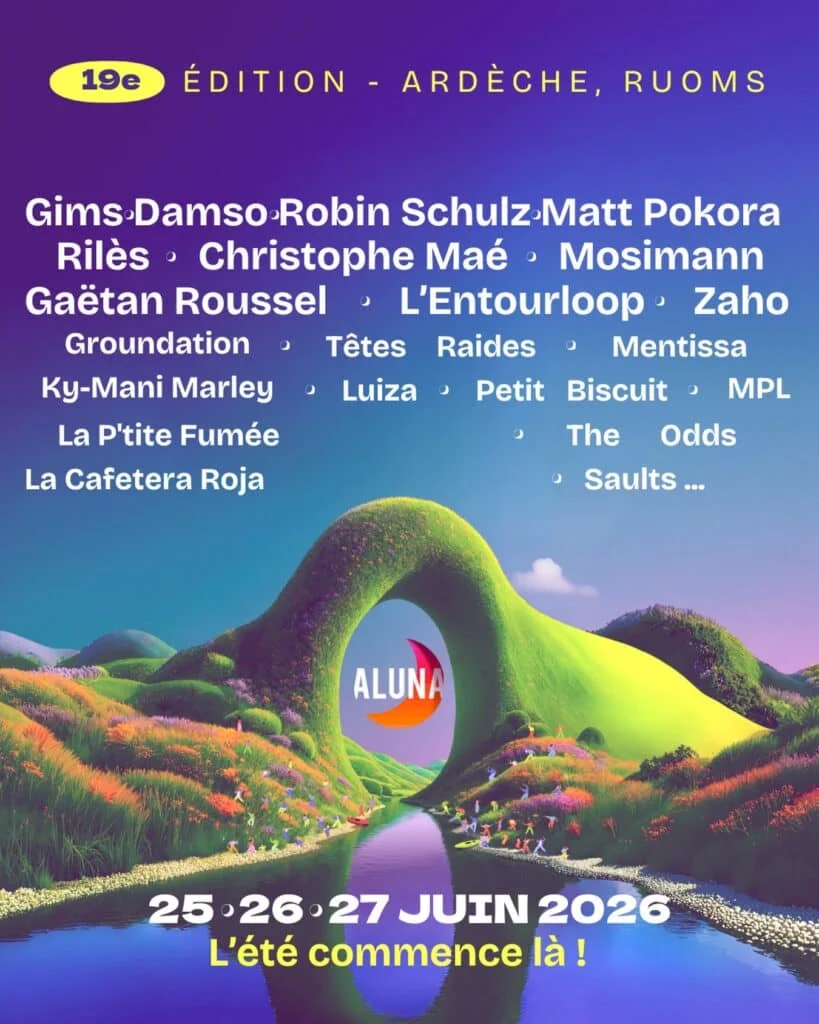
The 2026 edition shows its eclectic personality very clearly. Gims and Damso bring the lineup toward French-language rap, R&B and urban culture; Robin Schulz and Petit Biscuit open the door to melodic electronic music, dance and more nocturnal festival sounds; Matt Pokora and Christophe Maé represent a broad French pop line, accessible, singable and generational; Gaëtan Roussel and Têtes Raides connect with chanson, rock and French alternative tradition; L’Entourloop, Groundation, Ky-Mani Marley and La P’tite Fumée bring reggae, dub, world music, bass and a more travelling energy. That coexistence is exactly Aluna’s DNA: a festival where family playlists, urban culture, sunset reggae, radio pop and closing-time electronics can all share the same weekend.
The two main stages, Étoile and Météore, help organize that variety. The first carries the biggest and most popular names; the second allows the festival to breathe differently, to introduce discoveries, to move into less obvious sounds and to avoid depending only on headliners. That architecture allows Aluna to be large without becoming completely flat. People may arrive for Gims, Damso, Robin Schulz or Christophe Maé, but leave talking about Joe Bel, La Cafetera Roja, Sibaritas de la Calle, Luiza, Bijo or an artist they did not have on their radar. A festival like this works best when it not only confirms taste, but also opens windows.
The location is essential to its charm. Ruoms is not a major music capital, and that works in the festival’s favour. The experience is not limited to the site. It begins earlier, on the roads, in campsites, accommodation, rivers, holiday plans and groups arriving in Ardèche looking for more than just one concert night. Aluna lives very close to tourism, but not in the superficial sense of a “festival for visitors.” It is better understood as an event embedded in a territory of nature, sun, water, villages and routes. Going to Aluna can also mean discovering southern Ardèche.
Its tone is popular without being empty. That is a difficult balance. Many eclectic festivals feel like a simple sum of commercial artists. Aluna, instead, has a clear line as a French summer festival: broad, warm, intergenerational and open to several styles. It does not try to be the most radical event on the calendar, but it does not reduce itself to a radio formula either. Its programming allows parents, children, thirtysomethings who want to dance, teenagers following French rap, adults who know chanson, tourists drawn by the landscape and fans travelling for a specific artist to coexist in the same space.
The real experience probably feels warm from the beginning. You arrive in late-June heat, enter the site, locate the stages, load your cashless account, look for something to eat, cross paths with friend groups, families and holiday crowds, catch a set on Météore, move toward Étoile for a major name, dance to electronics or reggae, sing a song you knew without admitting it too much and end the night with that French summer feeling made of tiredness, dust, lights, collective choruses and holiday air. Aluna does not want to intimidate. It wants to gather.
Aluna Festival matters because it represents a strong European category: the regional festival that grew into a major event without stopping selling a territorial experience. It is not only pop, not only rap, not only reggae, not only electronic music. It is a contemporary music festival in the broad sense, with a strong sense of place, popular reach and a curatorial balance between recognizable names and discoveries. Its strongest image is not only an artist on the Étoile stage, but Ruoms lit up for three nights, the Gorges de l’Ardèche nearby, thousands of people singing under the June sky and a festival reminding everyone that summer can begin with a perfect mix of nature, culture and shared songs.
Genres
POP
ROCK
Timeline
One artist per year — highest ranked in our archive
Those who appear most across this franchise's editions.
 #1
#1Germany
1 editions · 2026
 #2
#2Belgium
1 editions · 2026
 #3
#3France
1 editions · 2023