Ranking
#228

FOLK - POP - ROCK
Ranking
#228
Followers
366.6 K
When
19–JUL 25, 2027
Featured artists
Lineup coming — we'll publish it as soon as it's confirmed.
Time left
20 editions to explore · future, live and past
 2027
2027Paleo Festival 2027
 2026
2026Paleo Festival 2026
Numbers, home base and house quirks
Some festivals arrive fully formed; others grow into their importance without cutting ties with the people and places that created them. Paléo belongs to the latter kind. Long before the stages, food stalls, late-night paths and enormous crowds, it was a three-day folk gathering held inside Nyon’s old community hall in April 1976. Around 1,800 people attended, Malicorne topped the bill, and the response persuaded the organisers that the idea was already too ambitious to remain indoors.
The following summer, the festival moved to Colovray, a lakeside meadow beside Lake Geneva. Music, bars and stalls spread across the grass, while a communal, post-Woodstock atmosphere gave the young event its first real identity. Folk remained in the name for several years, but not as a boundary. Blues, salsa, African and Brazilian rhythms, French chanson and rock quickly entered the programme. By the mid-1980s, a bill featuring The Cure, Téléphone, B.B. King and Toots and the Maytals made it clear that the original label no longer described the festival’s range.
Growth was never entirely smooth. Colovray became the subject of rent increases, legal disputes and property-development pressure, leaving the organisers to plan each edition while wondering whether the site would still be available the following year. In 1990, Paléo finally moved north of Nyon to the Plaine de l’Asse. The new ground offered room to expand, but it also required the festival to invent a new environment from scratch. Stages, temporary streets, public areas and visual landmarks gradually transformed an open plain into one of Switzerland’s most recognisable cultural meeting places.
Attending Paléo today feels less like visiting a conventional concert site than entering a temporary town built for six days and six nights. The Grande Scène carries the biggest productions, yet much of the festival’s character is found while moving between spaces: guitar bands in one tent, French-language rap elsewhere, electronic music stretching past midnight, a Swiss newcomer playing to an audience that arrived out of curiosity, and traditional sounds appearing only a short walk from mainstream pop. The challenge is rarely finding something worth hearing. It is deciding what to miss, judging the distance between stages and accepting that a carefully planned evening may be redirected by a performance discovered by accident.
The wider programme matters just as much. La Ruche brings circus and street arts into the middle of the grounds. Belleville gives electronic music its own late-night territory. Village du Monde focuses each year on a different region, combining concerts with food, craft, architecture and newly created scenery. Quartier Libre, located between the main site and the campsite, remains accessible without a festival ticket and adds fairground rides, bars, stalls and free entertainment. The campsite develops a rhythm of its own, filled with tents, communal meeting points, improvised breakfasts and conversations that continue long after the final encore.
Paléo’s audience is strikingly intergenerational. People who attended beside the lake now return with children or grandchildren, sharing the grounds with teenagers arriving for their first major festival. Rock loyalists, pop fans, club crowds, French chanson followers and families may all be present on the same day. That mixture keeps the event from becoming a monument to its own past. Its history is visible, but it is constantly challenged by new artists, unfamiliar sounds and audiences with no personal memory of the early years.
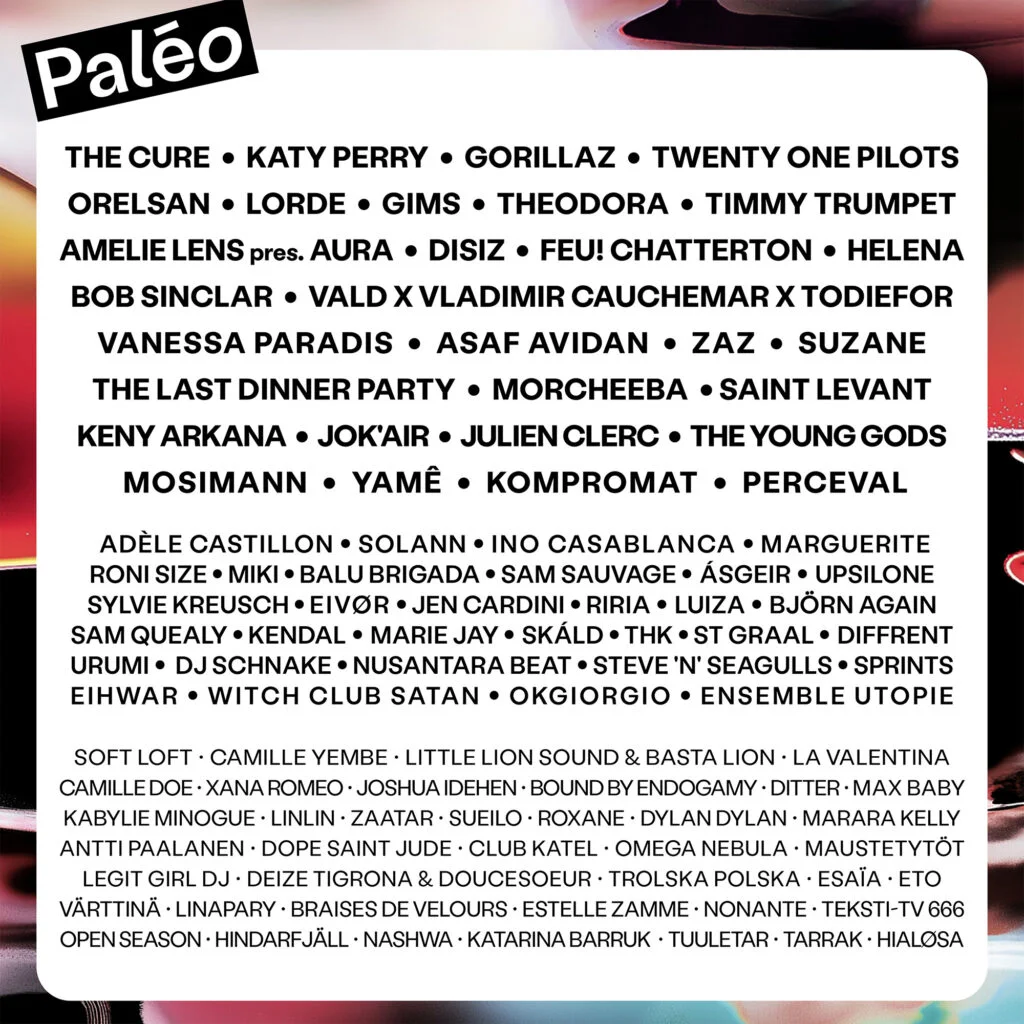
The 2026 edition runs from 21 to 26 July, with Twenty One Pilots, Lorde, The Cure, Gorillaz, Orelsan, Katy Perry, Gims and Timmy Trumpet among the leading names. Village du Monde turns towards Scandinavia and the Nordic countries, bringing together music, food and visual references drawn from the region. The bill captures Paléo’s central balancing act: a festival capable of hosting globally known headliners while still treating discovery, local talent and less familiar traditions as essential rather than decorative.
Paléo’s importance cannot be reduced to attendance figures or a list of famous performers. Its identity comes from the connection between music, place and a volunteer community that rebuilds the festival every summer. The stages, genres and layout have changed repeatedly, but the basic idea has endured: bring different generations together, give curiosity the same weight as celebrity and turn an ordinary Swiss plain into a place people remember long after it has returned to grass.
Genres
FOLK
POP
ROCK
Timeline
One artist per year — highest ranked in our archive
Those who appear most across this franchise's editions.
 #1
#1United States
1 editions · 2026
 #2
#2Spain
1 editions · 2023
 #3
#3United States
1 editions · 2023