Ranking
#1,247

COUNTRY - POP - ROCK
Ranking
#1,247
1 editions to explore · future, live and past
Numbers, home base and house quirks
The Big Red Bash begins long before the first performer walks onto the stage. For thousands of visitors, the experience starts on roads that cross small towns, isolated fuel stops and immense stretches of inland Australia. Caravans, campervans, cars and organised coaches move toward Birdsville until the normally quiet settlement becomes the centre of a nationwide road journey. From there, the final route continues roughly thirty-five kilometres toward Big Red, the dune standing near the eastern edge of the Simpson Desert. By the time Bashville appears, the festival is already underway. Reaching it is as important to the story as any song that will be heard over the following three days.
The event began on a much smaller scale in 2013. After the Big Red Run, a six-day, 250-kilometre charity ultramarathon, John Williamson performed on the dune for around five hundred runners, volunteers and visitors. The concert supported an event connected with juvenile-diabetes research and was initially an addition to the sporting programme rather than a separate festival. Yet the sight of Williamson singing Australian songs against the red desert suggested a larger possibility. The concert returned, developed its own identity and gradually became an annual gathering capable of drawing several thousand travellers from every part of the country.
Growth has never removed the sense of isolation. Bashville is built each year on a private organic cattle station where public camping is normally restricted. For a few days, internal roads, medical services, food traders, lighting, stages and thousands of campsites appear on the desert floor. Beyond that essential infrastructure, the environment remains demanding. There is no campsite drinking-water supply, no showers, no electricity, no fuel, no automatic teller machines and no dependable mobile reception. Each group must carry enough water, food, medication, tools, sun protection and clothing for cold nights. Comfort is determined less by what can be purchased on site than by how carefully the journey was prepared.
The concert stage sits below Big Red, allowing the dune to become a natural backdrop that no touring production could reproduce. Audiences bring camping chairs and occupy a broad open area where performances can be watched without the compression of a conventional stadium crowd. Australian rock, country, pop and familiar national repertoire dominate the programme. John Farnham, Jimmy Barnes, Midnight Oil, Paul Kelly, Tina Arena, Daryl Braithwaite, Icehouse, Hunters & Collectors, Kasey Chambers, Missy Higgins, Hoodoo Gurus, The Living End and Troy Cassar-Daley have all contributed to its history. Rather than relying on international imports, the Bash places Australian music in direct conversation with landscape and collective memory.
The days extend well beyond the stage. Visitors climb the dune for sunrise and sunset, play volleyball in the sand, take scenic flights and join activities designed for children and families. The Bashville Drags Race fills Big Red with sequins, feathers and costumes inspired by *Priscilla, Queen of the Desert*, followed by the Fashions in the Desert parade. Thousands perform the Nutbush together, while Big Blue Day once created a vast human image of Australia. These spectacles are deliberately humorous, but they serve a serious purpose. Entry fees and donations support the Royal Flying Doctor Service and other organisations whose work is particularly important in communities separated by enormous distances.
Camp life is as central as the concerts. Sites fill with awnings, portable kitchens, controlled fires and groups that have travelled hundreds or thousands of kilometres together. There is no hotel to return to when the final artist finishes. People walk back to their vehicles beneath a sky with almost no light pollution and spend the evening beside neighbours they may meet again on the journey home. The beauty of the setting should not be confused with ease. Dust enters equipment, temperatures fall rapidly and mechanical problems may occur far from the next workshop. These conditions encourage a culture of preparation and cooperation that is rarely as visible at an urban event.
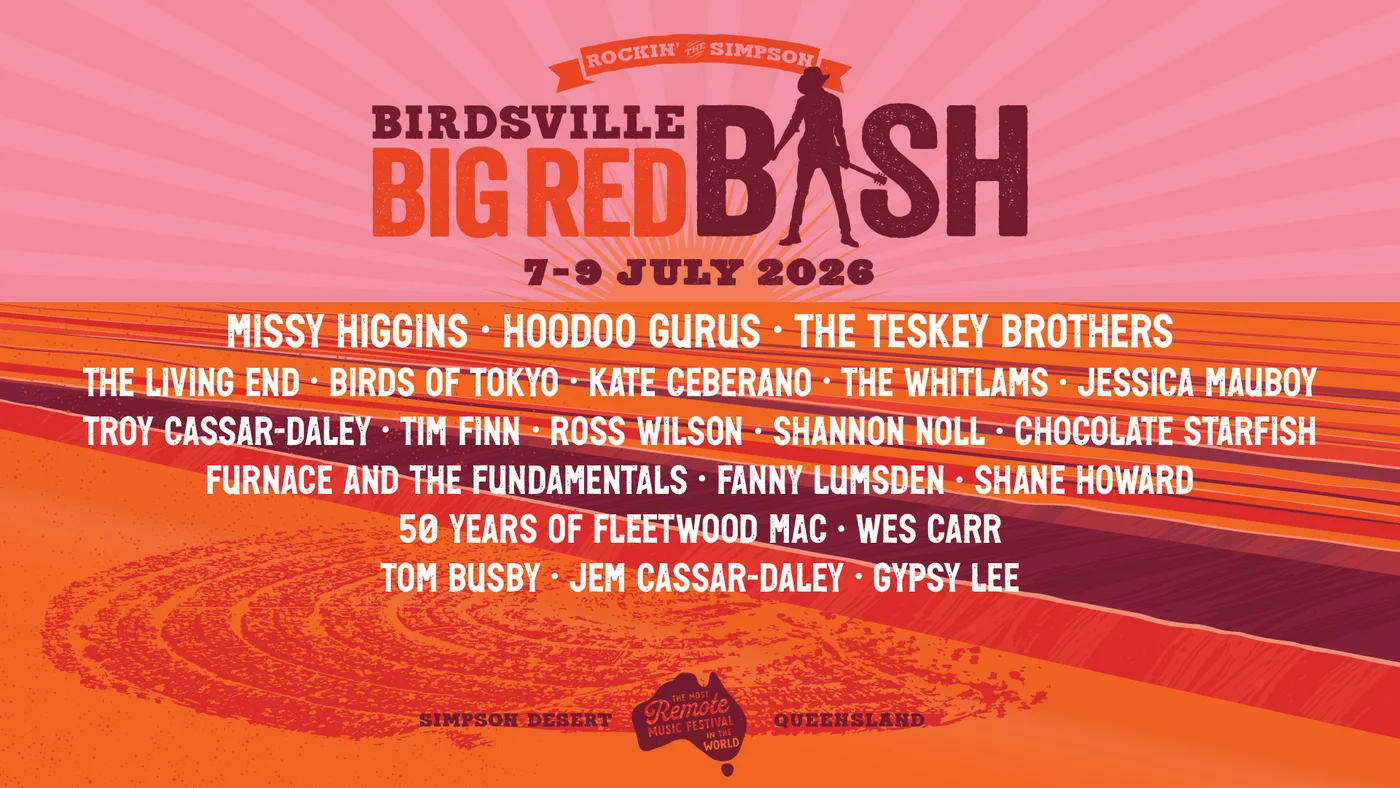
The last complete edition took place in July 2024, with Tina Arena, Jon Stevens, Ian Moss, Vanessa Amorosi and Chocolate Starfish among its prominent artists. After eleven years of increasingly complex operations, the team scheduled a rest year for 2025. John Williamson returned for two smaller sunset concerts, but the full Bash was not constructed. The festival was due to resume in 2026 with Missy Higgins, Hoodoo Gurus, The Teskey Brothers, The Living End, Birds of Tokyo, Jessica Mauboy and a broad survey of Australian popular music. Unprecedented rain and regional flooding left the Big Red site unable to dry in time, and relocation within the Birdsville region proved impossible.
The next Big Red Bash is confirmed for July 6–8, 2027. Most artists engaged for 2026 indicated that they intended to return, and ticket holders were allowed to transfer their bookings automatically. That continuity still depends on conditions no organiser can completely control. In the outback, rain, road access, fuel, distance and the condition of the land carry as much authority as artistic planning. The 2026 cancellation demonstrated that the desert is not a decorative theme applied to the event. The festival genuinely depends upon it and must accept when the environment says that gathering is not possible.
This relationship explains the Bash’s singular place in Australian festival culture. The lineup may include some of the country’s most recognisable performers, but the defining memory often includes the road, the first sight of Big Red, conversations between caravans and the silence after the final concert. For several days, the event builds a temporary community in one of the continent’s most remote environments and then returns the land to the desert. Its scale has changed dramatically since John Williamson’s first appearance, yet the original idea remains visible: Australian songs heard in a landscape that forces visitors to understand the country’s size, difficulty and capacity for connection.
Genres
COUNTRY
POP
ROCK
Timeline
One artist per year — highest ranked in our archive
Those who appear most across this franchise's editions.
 #1
#1Australia
1 editions · 2026
 #2
#2Australia
1 editions · 2026
#31 editions · 2026