Ranking
#184

INDIE - POP - ROCK
Ranking
#184
Followers
470 K
When
28–MAY 30, 2027
Where
Napa
Country
United States
Featured artists
Lineup coming — we'll publish it as soon as it's confirmed.
Time left
13 editions to explore · future, live and past
Numbers, home base and house quirks
BottleRock has one headliner no artist can negotiate with: 10 p.m. The Napa Valley Expo sits close enough to downtown and surrounding residential streets that houses effectively share the neighborhood with the main stage. After noise complaints following the inaugural year, a strict curfew became part of the festival's relationship with the city. The Cure, Foo Fighters, Neil Young and Guns N' Roses have all discovered that even rock history does not buy extra minutes. That hard stop explains BottleRock better than its luxury lounges do. This is a large festival embedded inside a functioning wine-country city, not a remote field temporarily exempt from ordinary life. Tens of thousands can spend the day drinking Napa Cabernet in front of major bands, but at ten the balance shifts back toward the people who live across the street.
The first BottleRock in 2013 was considerably less controlled. Its ambition was enormous: bring major touring acts to a region globally famous for wine and restaurants but not yet established as a large-scale music destination. The Black Keys, Kings of Leon, Zac Brown Band, Jane's Addiction and The Shins helped prove that audiences would come. Financially, however, the aftermath was disastrous. The original promoters accumulated roughly $8.5 million in debt, leaving vendors and other creditors chasing payments and making a second edition look doubtful. Napa entrepreneurs Dave Graham, Justin Dragoo and Jason Scoggins had experienced that first festival as attendees. Rather than watch the idea collapse, they formed Latitude 38 Entertainment, bought the BottleRock brand in early 2014 and began the far less glamorous job of persuading agents, suppliers, neighbors and the city that the name could be trusted again.
That rescue is where the modern festival really took shape. Latitude 38 guaranteed payment for its own edition, helped settle significant portions of debt it had not created and spent years rebuilding local credibility through meetings and practical changes. More importantly, the new team recognized that simply pouring decent wine beside a rock stage did not make a festival feel like Napa. Visitors arrived with expectations shaped by wineries, restaurants and hospitality businesses whose reputations depend on obsessive attention to detail. BottleRock therefore began treating local food and wine as core programming rather than premium decoration. Restaurants such as Morimoto, Mustards Grill, La Toque and PRESS became part of the experience; wine producers were integrated throughout the grounds. The festival found its identity when it stopped being a generic music event located in Wine Country and started behaving as though Wine Country itself had designed a music event.
The Culinary Stage pushes that idea far beyond ordinary festival catering. It is not a quiet demonstration tent where audiences learn knife skills between concerts. Chefs, musicians, athletes, actors and comedians are deliberately mixed until cooking becomes performance. José Andrés might work beside a rock star, Masaharu Morimoto can turn sushi into spectacle, and a professional athlete may end up singing instead of discussing food. In 2026, Emeril and E.J. Lagasse, Curtis Stone, Andrew Zimmern, Morimoto and other chefs shared the broader programme with guests ranging from members of the Backstreet Boys and Lil Wayne to Busta Rhymes and Jimmy Butler. The results can be chaotic, but that is the point. BottleRock does not ask visitors to choose between the serious culinary reputation of Napa and festival absurdity; it stages the collision and makes it one of the weekend's recognizable attractions.
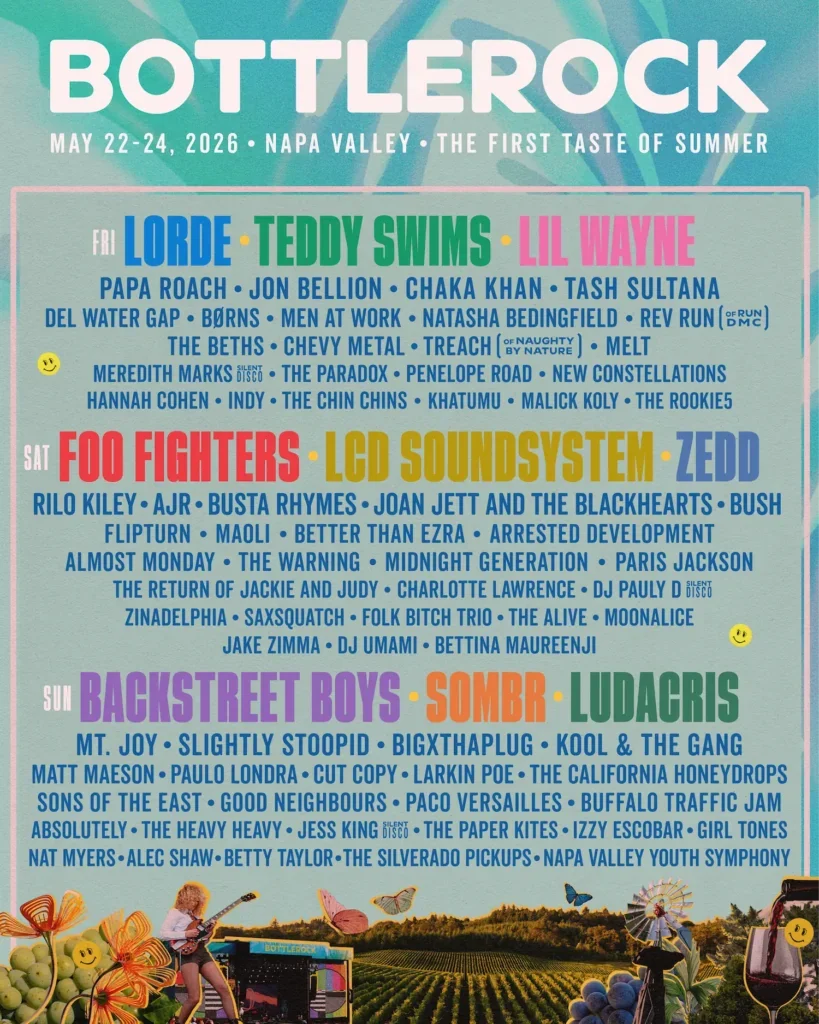
Musically, the event has moved in the opposite direction from specialization. Its early rock-heavy identity expanded into a broad survey of mass-audience music: Outkast, Snoop Dogg, Stevie Wonder, Bruno Mars, Metallica, Megan Thee Stallion, Lizzo, Post Malone, Green Day, Ed Sheeran and country artists have all fit somewhere in the same history. Many attendees buy into BottleRock as a weekend before knowing every name, giving promoters unusual freedom to connect generations rather than defend a scene. The sold-out 2026 edition made that clear. Lorde, Foo Fighters and Backstreet Boys provided the primary nightly anchors, while LCD Soundsystem, Teddy Swims, sombr, Lil Wayne, Zedd, Busta Rhymes, Ludacris, Chaka Khan, Kool & The Gang, Joan Jett and Bush stretched the bill across decades. The common denominator is not sound. It is familiarity, live appeal and the pleasure of unlikely adjacency.
The practical experience is equally distinct from the camping-festival model. Napa Valley Expo sits within the city, so there is no tent village and no expectation that visitors disappear into a temporary world for four days. People stay in Napa Valley hotels, downtown accommodations or farther across the Bay Area and use shuttles, public transportation, rideshare or walking routes. Once inside, five music stages offer enough choice without the enormous distances of a rural mega-festival. BottleRock's reputation for comfort is real, although access to its most elaborate version becomes expensive quickly: VIP Village, Skydeck platforms, private suites, premium culinary programmes, air-conditioned spaces and sommelier-level wine service turn festival hierarchy into architecture. Even general admission, however, benefits from a site built around permanent urban infrastructure rather than the compromises of a field and campsite.
That urban convenience creates obligations. Traffic, parking, trash and especially sound produced significant neighborhood opposition in the early years. Latitude 38 responded with revised site plans, sound mitigation, neighborhood meetings and a willingness to enforce the 10 p.m. cutoff even when it meant silencing famous musicians. Those incidents are funny only from a distance. When Foo Fighters lost amplification during “Everlong,” or Neil Young crossed the deadline, the underlying issue was whether BottleRock could continue operating next to people's homes without exhausting local goodwill. The official AfterDark programme offers a clever release valve: once Napa Valley Expo shuts down, selected artists continue in theaters, clubs and venues around Napa and the Bay Area. The festival night survives, but it moves somewhere designed to accommodate it rather than demanding that the Expo ignore its neighbors.
By 2026, the event that nearly collapsed after its debut had become a sold-out Memorial Day institution capable of bringing roughly a weekend's worth of pop generations into downtown Napa while simultaneously turning chefs and celebrities into secondary headliners. BottleRock will return May 28–30, 2027, again at the Napa Valley Expo. Its durability is not really a story about wine making a music festival more luxurious. It is about discipline: rebuilding a damaged business, learning the expectations of a hospitality region and accepting that a festival in the middle of town survives only through repeated negotiation. At 9:59 p.m., a global star can still command the entire field. A minute later, the power of Napa's neighborhood agreement becomes greater than the power of the stage.
Genres
INDIE
POP
ROCK
Timeline
One artist per year — highest ranked in our archive
Those who appear most across this franchise's editions.
 #1
#1United States
1 editions · 2023
 #2
#2United States
1 editions · 2023
 #3
#3United States
1 editions · 2023