Ranking
#60

INDIE - POP - ROCK
Ranking
#60
Followers
1.8 M
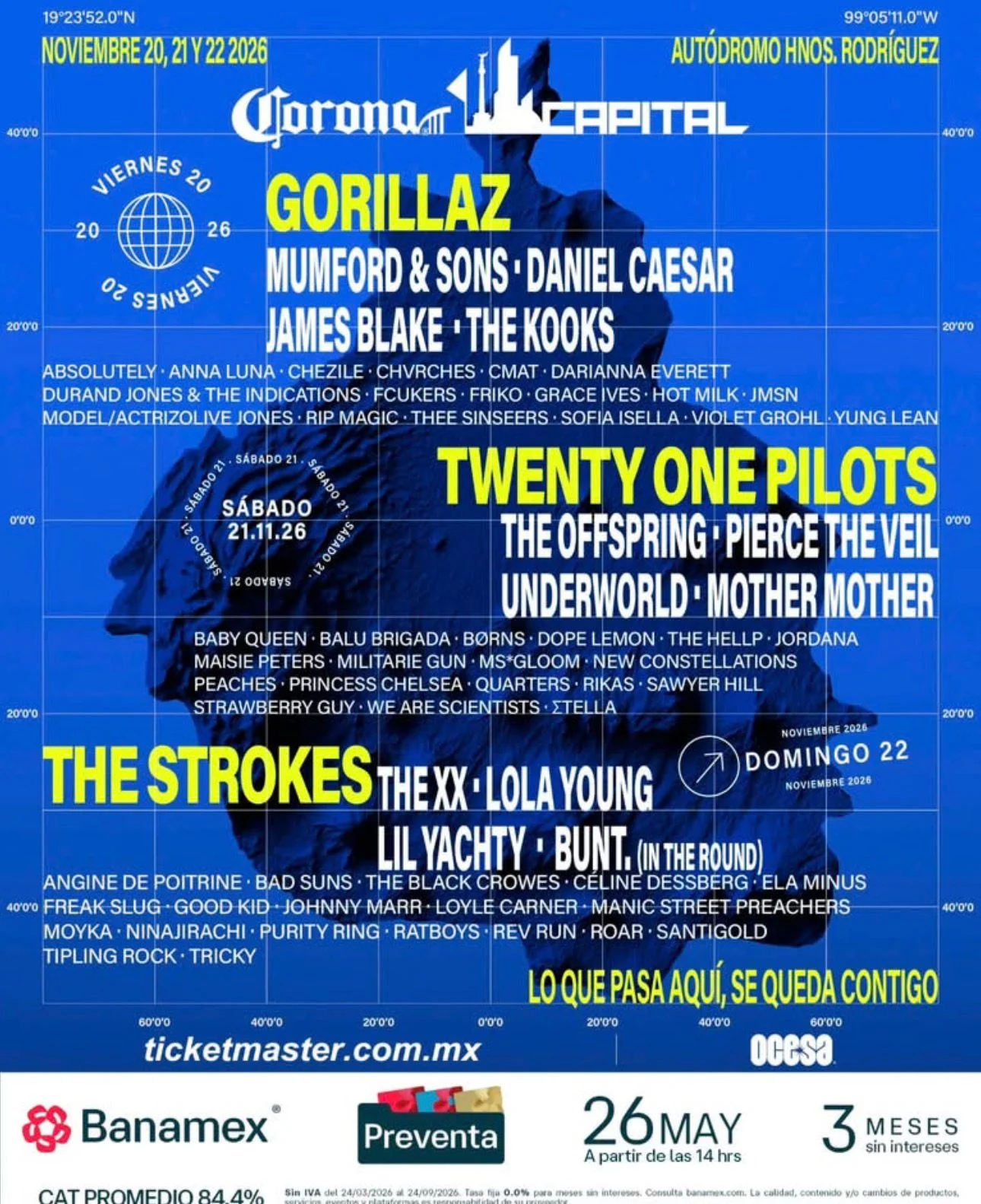
When
20–NOV 22, 2026
Where
Ciudad de México
Country
Mexico
Time left
16 editions to explore · future, live and past
2026Corona Capital 2026
 2025
2025Corona Capital 2025
Numbers, home base and house quirks
Corona Capital is one of the festivals that changed the way Mexico City experiences international music. It began in 2010 at Curva 4 of the Autódromo Hermanos Rodríguez with an idea that felt both ambitious and necessary at the time: to create a festival capable of bringing a strong international program to Mexico, especially focused on alternative rock, indie, electronic music, pop, post-punk and sounds that many Mexican fans had followed for years from a distance, through imported records, blogs, videos, forums and isolated concerts.
The first edition already made clear the kind of identity Corona Capital wanted to build. Pixies, Interpol, James, Echo & The Bunnymen, Regina Spektor, Foals, The Temper Trap, White Lies, Two Door Cinema Club and several Mexican and Latin American names formed a lineup that spoke directly to a generation that had grown up listening to English-language music with an almost private devotion. For many attendees, that first Corona was not just another festival: it was the feeling that Mexico City could finally have its own event for an audience living between guitars, synthesizers, British nostalgia, American indie and internet discoveries.
The Autódromo Hermanos Rodríguez became essential to that story. It is not a bucolic park or an intimate venue; it is a huge space of asphalt, dust, grandstands, long entrances and open sky inside one of the most intense cities on the continent. Going to Corona Capital means understanding Mexico City logistics: arriving by Metro, walking from Ciudad Deportiva or Puebla, finding the right entrance, going in while the sun is still strong, locating stages, loading the cashless wristband, deciding where to eat, calculating distances and accepting that the body will be tired before the final headliner ends. That mixture of city, crowd and physical endurance is part of its personality.
Musically, Corona Capital has long worked as an emotional map for Mexican fans of international music. Its programming can move through alternative rock, indie, synth-pop, electronic music, global pop, punk, new wave, folk, R&B, alternative hip-hop and cult acts. The festival has learned to speak to several generations at once: names that trigger nostalgia for those who grew up in the 1990s and 2000s, current artists dominating playlists, bands finally arriving in Mexico after years of waiting and projects discovered almost by accident while walking between stages.
One of its greatest strengths is that mix of excitement and conflict. At Corona Capital, schedule clashes are part of the ritual. You have to choose between the artist you waited half your life to see and the new act everyone is recommending. You have to decide whether to stay near the main stage to secure a good spot or run across the Autódromo for a smaller set. There are moments when the festival becomes a negotiation among friends: some want to dance, others want to cry to an old song, others need food, others want merch, and others can no longer feel their feet. That tension does not ruin the experience; it defines it.
Corona Capital also has a very special relationship with nostalgia. Many of its lineups seem designed to awaken memories: bands that soundtracked adolescence, songs that lived on MP3 players, albums shared during university years, artists who once seemed impossible to see in Mexico and reunions that turn a festival night into a generational gathering. But the festival does not live only in the past. It has remained relevant because it mixes those names with new artists, contemporary pop, current electronic music and projects that show where the global musical conversation is moving.
The real experience of the festival is deeply tied to Mexico City: lines, traffic, street vendors around the venue, groups with carefully planned outfits, jackets tied around waists, dust on shoes, expensive beers, lost friends, messages that fail because the signal disappears, stages that feel farther away than the map promised and a crowd suddenly singing a song in English as if it were an emotional national anthem. Corona Capital works because it turns Mexico City into a huge meeting point for music obsessives, nostalgic fans, curious listeners, intense fandoms and people hoping to discover the next act that will change their week.
Over time, the festival moved from being a niche bet to becoming an institution in the Mexican music calendar. Its size grew, its duration expanded, its lineups became increasingly ambitious and its name settled in as one of Latin America’s major festival brands. Corona Capital is not only an international music festival: it is an annual date with the sonic memory of several generations and with the idea that Mexico can receive, adopt and make its own a global musical conversation.
Genres
INDIE
POP
ROCK
Timeline
One artist per year — highest ranked in our archive
Those who appear most across this franchise's editions.
 #1
#1Canada
2 editions · 2023–2026
 #2
#22 editions · 2023–2026
 #3
#3Ireland
1 editions · 2023