Ranking
#19

INDIE - POP - ROCK
Ranking
#19
Followers
4.3 M
When
AUG 01, 2027
Featured artists
Lineup coming — we'll publish it as soon as it's confirmed.
Time left
21 editions to explore · future, live and past
 2027
2027Lollapalooza Chicago 2027
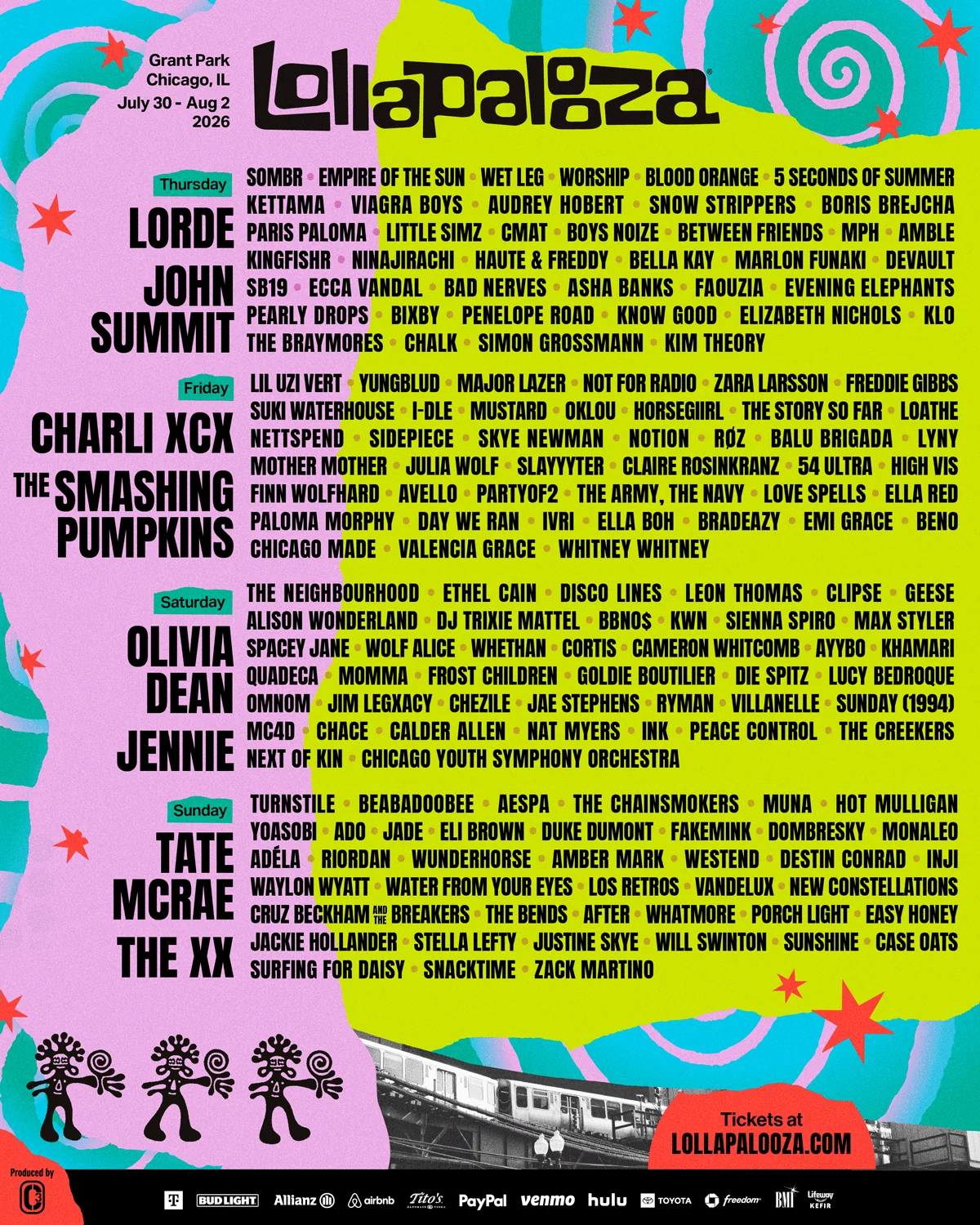 2026
2026Lollapalooza 2026
Numbers, home base and house quirks
Lollapalooza is one of those festivals that did not simply change lineups; it changed the idea of what a festival could be. It began in 1991 as a farewell tour for Jane’s Addiction, imagined by Perry Farrell, but it quickly became much larger than the ending of one band. Lollapalooza was an alternative caravan, a traveling cultural collision that carried rock, punk, metal, hip-hop, performance, weirdness, activism and attitude across the United States and Canada at a moment when alternative culture was about to break into the mainstream.
Its first era had a very different energy from European field festivals or today’s large corporate events. Lollapalooza moved. It arrived in a city, built its world, set it on fire symbolically and moved on to the next point on the map. On the same route, you could find Jane’s Addiction, Nine Inch Nails, Ice-T, Rollins Band, Butthole Surfers, performance artists, political booths, tattoos, zines, skaters, punks, metalheads, curious outsiders and teenagers who felt that someone was finally showing them a less domesticated version of music. It was not just a long concert. It was a statement of identity.
In the 1990s, Lollapalooza helped define what many people understood as “alternative.” Not because everything it booked was marginal, but because it mixed scenes that had not always shared the same space. That was its revolutionary gesture: forcing genres, tribes and tensions into conversation. One festival could hold abrasive guitars, confrontational hip-hop, industrial noise, punk, funk metal, strange art and social messages. Lollapalooza did not promise comfort. It promised discovery, noise, sweat, conflict and the feeling of entering a culture that was not asking for permission.
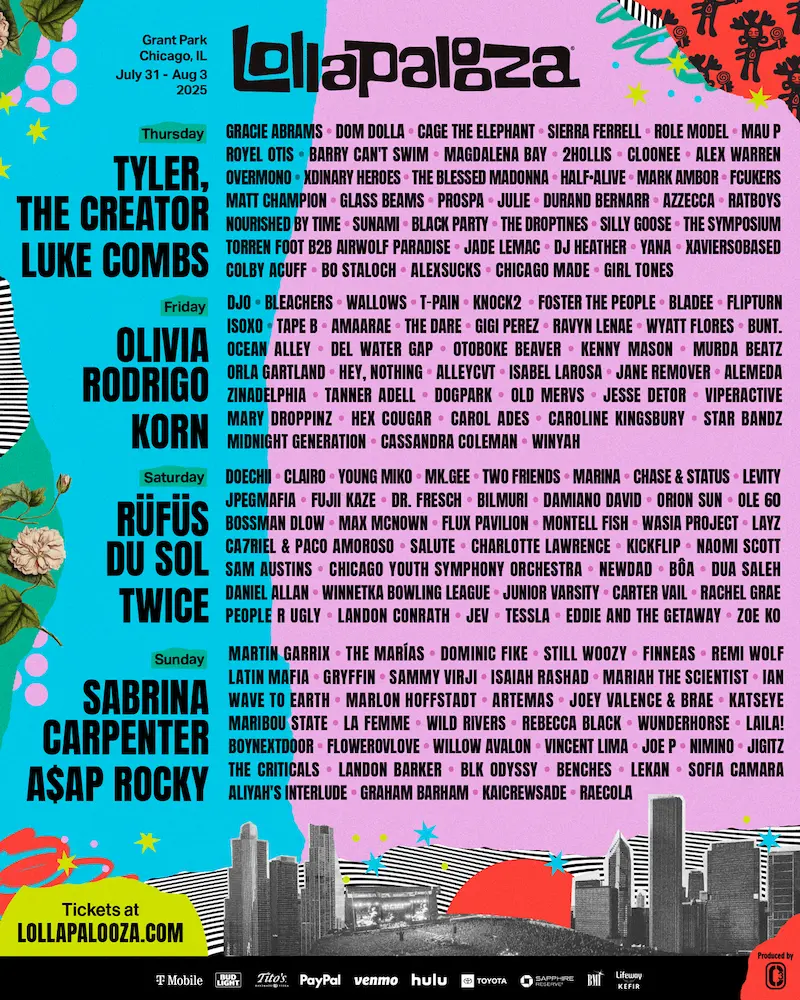
After the traveling model wore itself out, the festival went through pauses, attempted returns and then a decisive transformation: in 2005, it found a permanent home in Grant Park, Chicago. That change could have killed it symbolically, because Lollapalooza had once meant movement. Instead, it gave the festival a second life. Chicago turned it from a caravan into a music city inside another city, with the skyline as a backdrop, Lake Michigan nearby, aftershows in beloved venues and an international audience traveling in for four days of music in the middle of an urban landmark.
The modern edition is broader, cleaner and more global than the original. Lollapalooza no longer belongs only to alternative rock. Today it can bring together pop, hip-hop, electronic music, indie, punk, K-pop, Latin music, dance, nostalgia, emerging artists and world-scale headliners in the same weekend. That range can spark debate among those who miss its more rebellious spirit, but it also explains its survival. Lollapalooza understood that “alternative” stopped being one single aesthetic and became a form of open curation: placing artists from different moments of popular culture on the same map.
Grant Park is central to the contemporary charm. Few urban festivals have such a recognizable natural setting: skyscrapers, parkland, avenues, museums nearby, trains, hotels, restaurants and the feeling that the entire city has shifted into festival mode. The audience does not vanish into an isolated field. It inhabits Chicago. During the day, fans move between stages; at night, they may continue into aftershows, bars, streets, hotel lobbies or the long internal debate over whether the exhaustion is worth one more set. Lollapalooza is not camping and it is not rural escape. It is urban immersion.
It also has a civic and family-friendly dimension that makes it different. Kidzapalooza, community programs, Chicago partnerships and the festival’s economic and cultural footprint make it more than a sold-out weekend. That does not erase its contradictions. It is huge, commercial, sponsored, expensive and very different from the wild creature of 1991. But that is exactly its story. Lollapalooza went from a farewell tour to a global institution.
Today, with editions in countries such as Chile, Argentina, Brazil, Germany, India and other markets, Lollapalooza functions as a cultural franchise able to adapt to different cities while keeping its mythic name intact. Chicago remains the emotional center. Lollapalooza matters because it survived its own era. It was born as an alternative roar, aged, reinvented itself and proved that a festival can change shape without completely losing its first electricity.
Genres
INDIE
POP
ROCK
Timeline
One artist per year — highest ranked in our archive
Those who appear most across this franchise's editions.
 #1
#1Philippines
2 editions · 2023–2026
 #2
#2United Kingdom
2 editions · 2023–2026
 #3
#3United States
2 editions · 2023–2026