Ranking
#255

HIP HOP - HOUSE - TECHNO
Ranking
#255
Followers
322.1 K
When
2027
Featured artists
Lineup coming — we'll publish it as soon as it's confirmed.
6 editions to explore · future, live and past
Numbers, home base and house quirks
Delta Festival occupies a stretch of Marseille where the city opens directly onto the Mediterranean. From the middle of the afternoon, the Plages du Prado begin filling with groups arriving by metro, bus, bicycle or on foot. The sea remains visible behind the production structures, summer heat shapes the first hours and each stage develops a different identity within a site combining an urban beach, broad promenades, palm trees, activities and large-scale live entertainment.
The project was created in 2014 by Matthieu Predal and Olivier Ledot, with its first widely documented public edition following the next year. At that point, Delta felt closer to a large student-association gathering than the major festival it would eventually become. A single music stage sat beside sports, games and youth organisations, while an electronic programme brought together students from Marseille and other cities across southern France.
Growth came quickly. The modest installations of the early years expanded into multiple stages, international artists, elaborate visual productions and audiences travelling from across the country. Electronic music remains the most visible foundation, but the festival no longer belongs to one scene. House, techno, hard dance and melodic club music sit beside French rap, pop, urban sounds and live performances. A visitor can move from a veteran DJ to an emerging rapper and finish with a much heavier electronic set without leaving the same seafront site.
Daylight gives the experience a distinctive rhythm. Concerts are combined with sports, water-based activities, food areas and shaded places offering relief from the Marseille sun. Towards evening, Mediterranean light becomes part of the stage environment, especially on areas facing the water. After dark, screens, lighting and sound turn the coastline into a vast dance floor, while pool parties and official after-events extend the programme into other parts of the city.
Delta is not limited to entertainment. Le Monde des Possibles occupies a substantial part of the grounds and has developed into one of France’s largest youth forums. Its themed villages bring together associations, public institutions, businesses, NGOs and community initiatives working on health, inclusion, environmental protection, employment, entrepreneurship, culture, international mobility and the future of the coastline. Between sets, visitors can encounter workshops, career opportunities, volunteer programmes, exhibitions and prevention campaigns.
The Scène des Possibles gives those subjects their own stage. Artists, researchers, entrepreneurs, activists and digital creators participate in discussions, while public agoras invite festival-goers to debate and vote on proposals affecting younger generations. This programme is not hidden away from the music. It is placed within the normal movement of the site and uses the attraction of a major festival to lead thousands of visitors towards conversations they might not otherwise seek out.
A gathering of this size must also address its physical impact. Waste teams, free drinking-water stations, restrictions on disposable plastic and beach-cleaning projects aim to reduce the amount left behind beside the sea. Safe Delta provides trained mobile teams, a refuge and support area, harm-reduction material and assistance in cases involving harassment, discrimination or personal distress. These measures recognise that several hours of dancing in summer heat among tens of thousands of people require more than an impressive lineup.
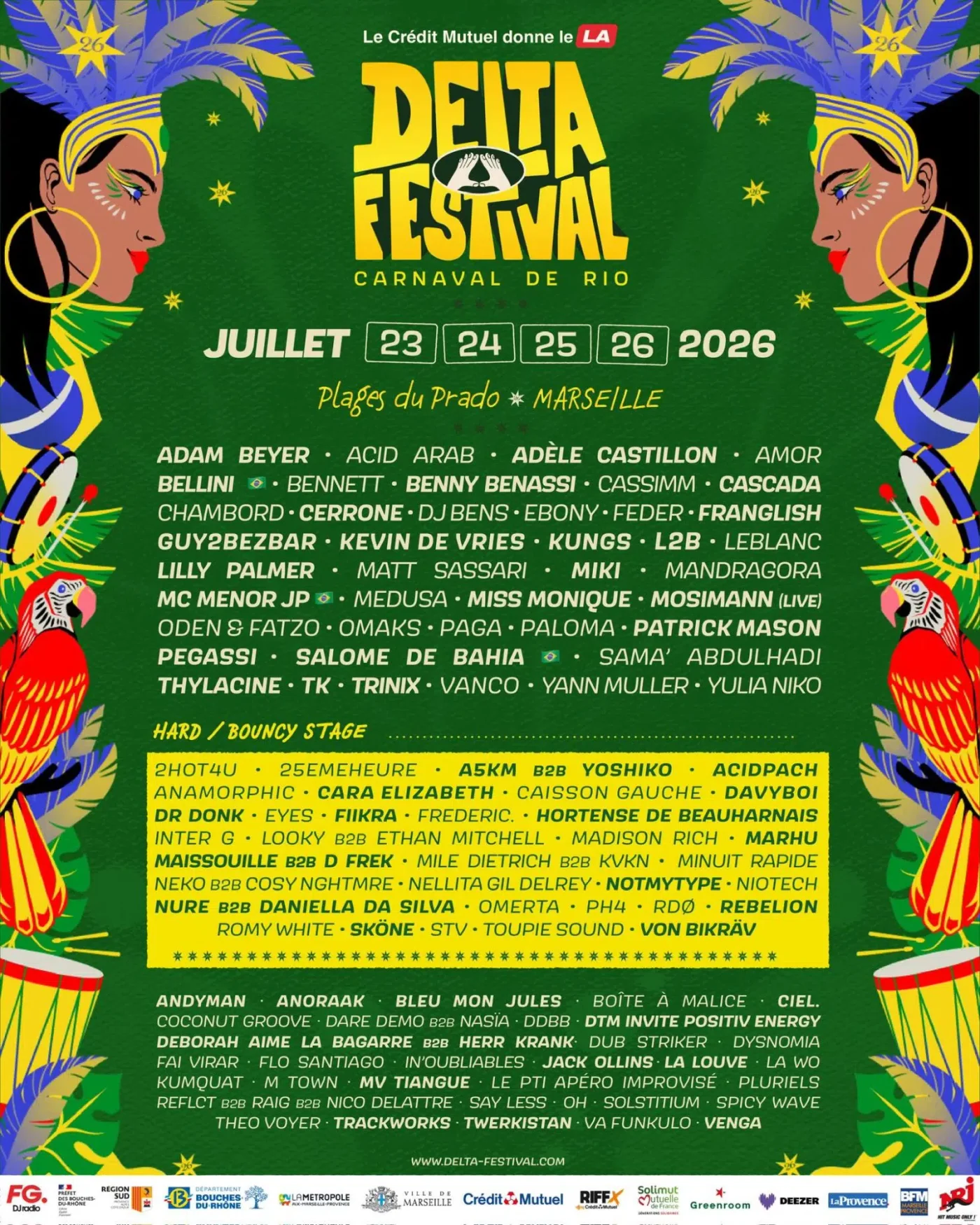
The 2026 edition takes place from 23 to 26 July under the concept “DO BRASIL – Bienvenue à Delta Cabana.” The energy and imagery of Rio Carnival shape the weekend through costumes, colour, makeup, parades and tropical scenography. Kungs, Adam Beyer, Benny Benassi, Cascada, Cerrone, Meduza, Mosimann, Lilly Palmer, Miss Monique, Kevin de Vries, Acid Arab, Trinix, Feder, Franglish, L2B, MIKI and Thylacine represent a programme moving between accessible electronic music, techno, house, rap and pop.
Delta Festival has become a major summer celebration without completely abandoning its student and community origins. Its character lies in the contrast between partying and public discussion, between enormous electronic production and social initiatives, and between beach, city and Mediterranean horizon. For four days, the Plages du Prado become more than a leisure area: they operate as a temporary city built around dancing, discovering new ideas and taking part.
Genres
HIP HOP
HOUSE
TECHNO
Timeline
One artist per year — highest ranked in our archive
Those who appear most across this franchise's editions.
 #1
#1Mexico
2 editions · 2023–2026
 #2
#2France
2 editions · 2023–2026
 #3
#3France
2 editions · 2023–2026