Ranking
#737

METAL
Ranking
#737
Followers
59.7 K
When
2027
Featured artists
Lineup coming — we'll publish it as soon as it's confirmed.
7 editions to explore · future, live and past
Numbers, home base and house quirks
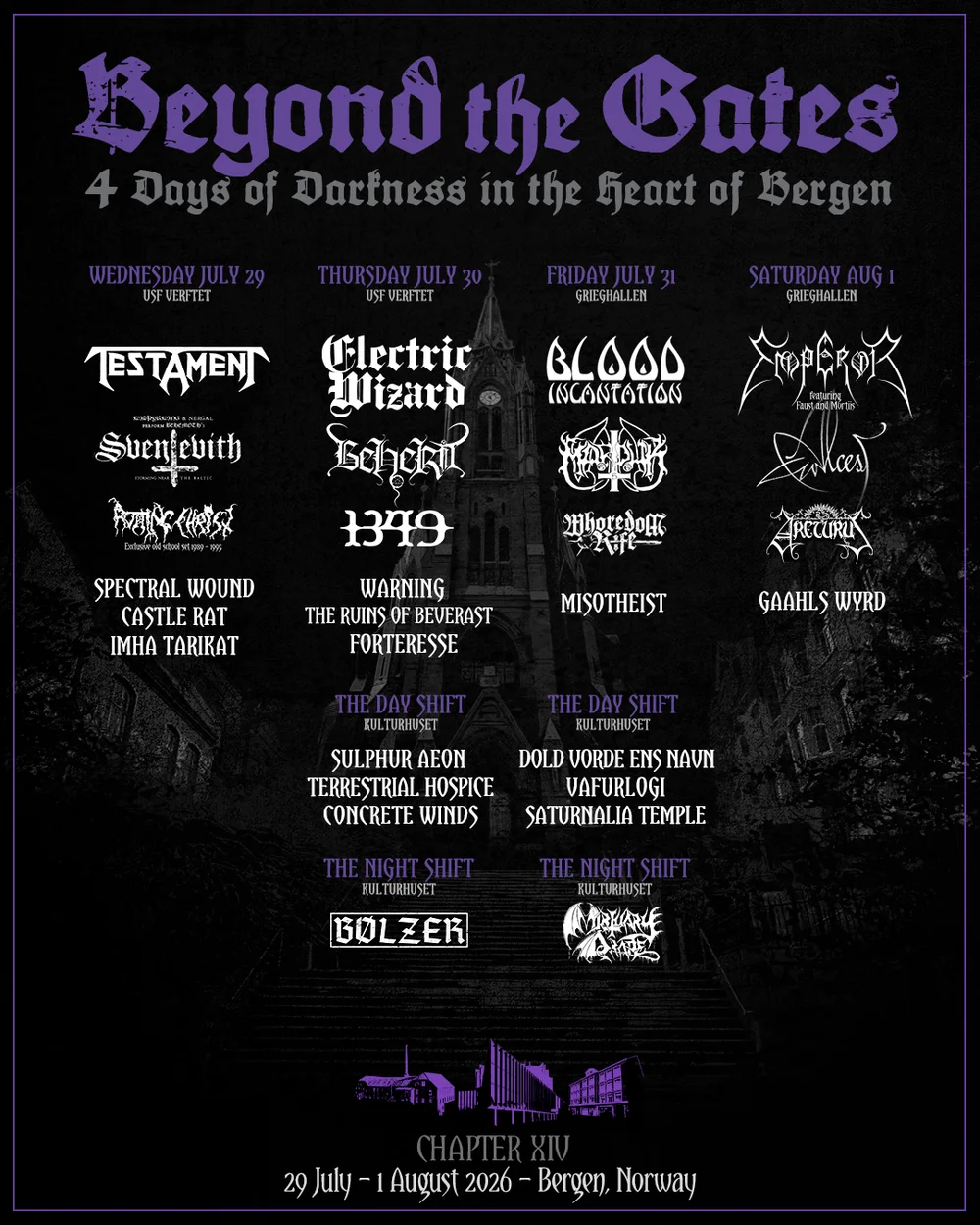
Beyond the Gates turns Bergen into more than the city in which a festival happens. For several days, streets, venues, record shops, bars, galleries and historic buildings become parts of a route built around extreme metal. Audiences do not enter an isolated field outside town or sleep in a campsite removed from urban life. They stay in the centre, walk between shows and discover that many of the cultural references behind the lineup already belonged to Bergen long before the festival existed. USF Verftet stands beside the water inside a converted factory, Kulturhuset holds club shows and daytime discussions, while Grieghallen carries a historical weight that would be difficult to reproduce elsewhere. Seminal Norwegian black-metal records were made inside that building, so hearing related artists there connects repertoire, architecture and memory in an unusually direct way.
The story began in 2012, shortly after Hole in the Sky had ended its own influential run. Torgrim Øyre was then booking concerts at Garage, a club where many of Bergen’s underground relationships had developed. The initial plan was modest: arrange several bands so that regular visitors could meet again during the late-August weekend they had previously spent together. It grew into three nights and fifteen performances covering black, thrash, death, doom and traditional heavy metal. Tortorum, Svartidauði, Mare, Deathhammer, Nekromantheon, Solstice and In Solitude formed a programme without conventional commercial headliners, aimed at people who followed demos, independent labels and emerging scenes. That first year established a principle the festival still uses: a band’s importance is not determined only by audience size, but by the intensity with which it represents a tradition or suggests a new direction.
The early editions were small and physically immediate. Garage’s basement removed almost every barrier between musicians and audience, but it also limited production and capacity. The move to USF Verftet in 2017 changed the scale without completely abandoning the atmosphere. A former sardine factory offered a larger hall, an additional stage and the infrastructure required for specially constructed performances, while retaining an industrial relationship with Bergen’s harbour. That edition included Mayhem playing *De Mysteriis Dom Sathanas*, Enslaved presenting *Vikingligr Veldi*, Master’s Hammer returning to an indoor stage after decades and Sumerlands making its European live debut. Beyond the Gates still spoke to underground listeners, yet it had begun using its curatorial position to create concerts that could not simply be encountered on an ordinary tour.
This approach became one of its most valuable qualities. Beyond the Gates does not only book recognised artists and arrange them on a poster; it tries to connect performers, Bergen’s history and the room in which each show takes place. Enslaved have returned to perform complete albums recorded at Grieghallen, while Satyricon occupied the hall for two different career-spanning sets. Blood Fire Death gathered musicians from several generations to celebrate Quorthon and Bathory, and the reunion of Gehenna’s original lineup brought formative Bergen material back into its home city. These projects make use of nostalgia without settling for straightforward reproduction. Albums, lineups and repertoires are reconstructed through productions designed specifically for the festival, allowing familiar music to take on another meaning in the place from which much of its culture emerged.
The addition of Grieghallen expanded this conversation between past and present. It is a formal concert hall associated with Edvard Grieg and Bergen’s official cultural life, yet it also contains the studio where Pytten recorded essential work by Mayhem, Emperor, Enslaved and Immortal. When extreme metal takes over its main stage, the music is no longer treated as an outsider culture separated from the city’s recognised history. The dimensions, acoustics and seated layout enable performances unlike those in a basement club: long-form repertoire, theatrical productions, complete albums and projects requiring room to unfold. At the same time, Kulturhuset preserves a smaller scale through Day Shift and Night Shift shows, where less established acts can meet a knowledgeable audience without becoming invisible beneath the main headliners.
The festival day does not begin or end with bands alone. Beyond the Gates Experience organises visits to black-metal landmarks, trips to the Lysekloster ruins, tours of Grieghallen’s studio, exhibitions, panels, interviews and meetings with musicians, producers and visual artists. These activities appeal to listeners who already know the smallest details of the scene, but they can also distinguish documented history from mythology and simplified tourism. Bergen remains a real city of Hanseatic heritage, museums, mountains, fjords, rain, food and neighbourhoods that existed before they became symbols within metal culture. The festival draws on that richness without reducing it to church fires, corpse paint and forest photography. For many international visitors, the trip combines four days of concerts with cultural pilgrimage, city travel and exploration of western Norway.
The absence of camping changes the social rhythm. Each morning, the audience reappears in cafés, hotels, record shops and central streets; by afternoon, black shirts gather again outside the venues. Visitors can sleep in a proper room, eat beyond festival concessions and build their own route through Bergen, yet the schedule can still be impossible to complete. Main performances, club sets, tours and parallel activities force choices. That abundance does not make Beyond the Gates feel anonymous. It retains a recognisable community of returning visitors from dozens of countries, along with artists who often remain in the audience after finishing their own shows. The line between performer, organiser, historian and fan becomes less rigid over the course of the week.
Beyond the Gates has grown from a basement gathering into one of extreme metal’s most respected international meetings, but its identity still depends on careful curation and its relationship with Bergen. It can present King Diamond, Opeth, Emperor, Mayhem, Behemoth or Testament without abandoning bands only beginning to travel beyond their local scenes. Its value lies not merely in assembling famous names, but in giving each artist a place within a broader discussion about black metal, death metal, doom, memory, geography and artistic change. Between the harbour, the clubs and Grieghallen, the festival shows how a musical scene can acknowledge its history without becoming trapped inside it, opening the gates for the past to return transformed and for the underground to imagine what may come next.
Genres
METAL
Timeline
One artist per year — highest ranked in our archive
Those who appear most across this franchise's editions.
 #1
#1Sweden
2 editions · 2023–2026
 #2
#2France
2 editions · 2023–2026
 #3
#3United States
2 editions · 2023–2026