Ranking
#134

HOUSE - TECHNO - TRANCE
Ranking
#134
Followers
733.6 K
When
AUG 01, 2027
Featured artists
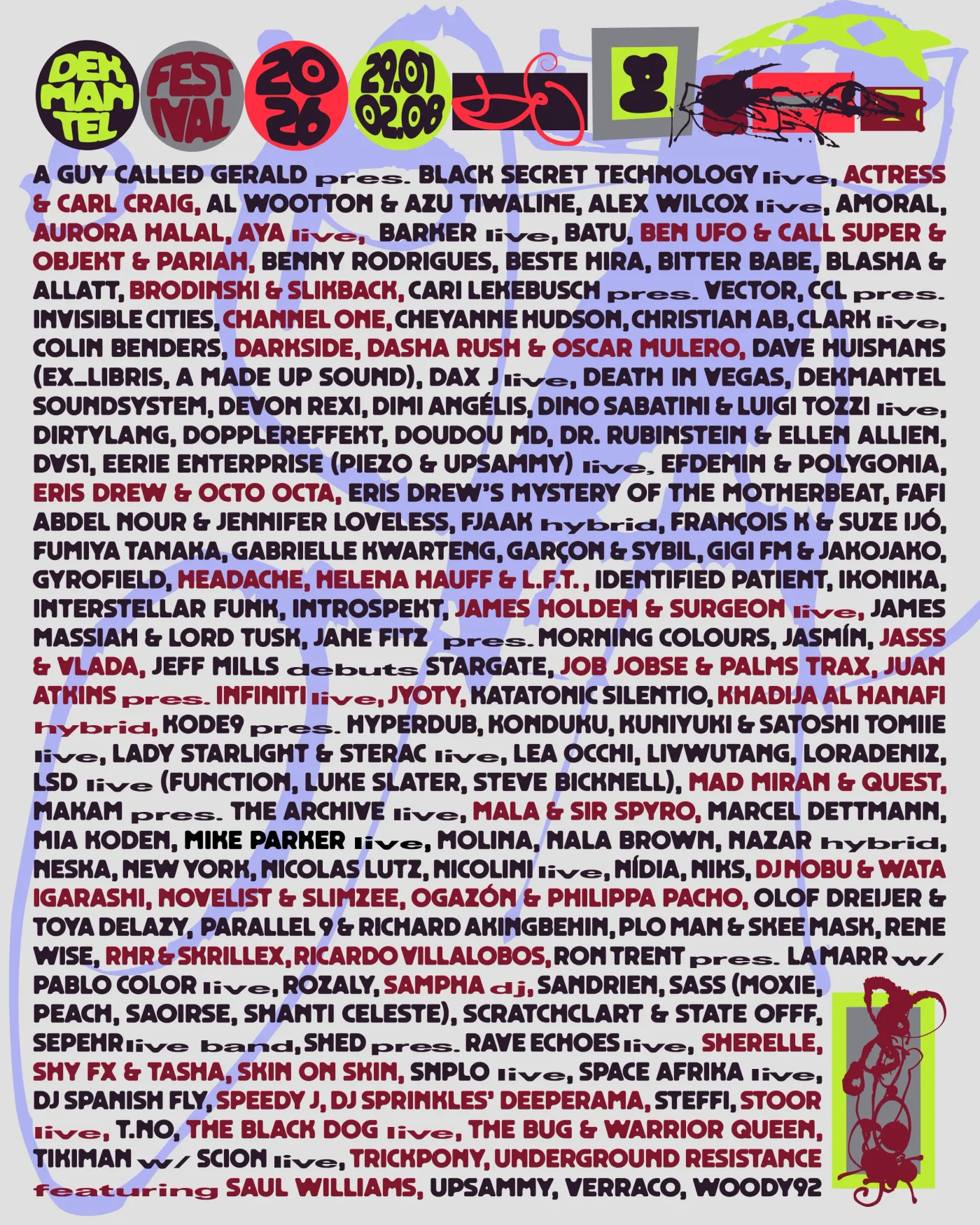
Lineup coming — we'll publish it as soon as it's confirmed.
Time left
9 editions to explore · future, live and past
Numbers, home base and house quirks
There is a question that almost every Dekmantel attendee ends up asking at some point during the weekend, usually while standing somewhere in the Amsterdamse Bos with a bass line resonating through their ribcage and the smell of trees in the air: how does something like this actually exist?
It is not a question about production budgets or logistics. It is the question that surfaces when the setting and the music and the crowd all feel genuinely aligned, when the experience is not a simulacrum of underground culture but the thing itself, scaled carefully and protected deliberately over more than a decade.
The story begins before the festival. Thomas Martojo and Casper Tielrooij grew up in The Hague and spent their adolescence taking the train to techno parties in Amsterdam and Rotterdam. By 2007 they had moved to Amsterdam and were throwing their own nights with a specific philosophy: to bring the Detroit sound they felt the city was missing. Robert Hood and Moodymann were among their earliest bookings — artists who were personal heroes long before they became lineup currency. In 2009 the record label was founded. And in 2013, after six years of building a community from inside club rooms, they made the move into the forest.
The first Dekmantel Festival took place in August 2013 at the Amsterdamse Bos, a public woodland park constructed between 1934 and 1967 as a public works project, larger than Central Park. The lineup that year told you immediately what this festival intended to be: Âme, Ben Klock, Ben UFO, Carl Craig, Dixon, DJ Koze, Four Tet, Jeff Mills, Juan Atkins and Moritz von Oswald, Laurent Garnier, Joy Orbison, Marcel Dettmann. This was not the program of a festival searching for its identity. It was the program of one that already knew exactly who it was.
What separates Dekmantel from almost every other electronic music festival of comparable reputation is the deliberate absence of spectacle hierarchy. There is no single headliner who functions as the gravitational centre of the weekend, no giant LED screen competing with the music, no structure that obscures the trees. The stages — including the UFO, a dome that has become genuinely iconic within electronic music culture — are built to make sound and forest the protagonists. People drift between sets, get lost, stumble into an artist they had never heard of on a smaller stage, arrive late somewhere because the previous set had not yet finished its thought.
Curation is the structural backbone of everything Dekmantel does. Closing the main stage at the Bos on Sunday has become, within the circuit, a genuine marker of artistic standing — an acknowledgment that carries real weight. The festival has consistently programmed emerging artists alongside Detroit veterans, experimental work alongside dancefloor techno, long-form sets alongside shorter disruptions that reframe what came before. Being invited to play Dekmantel says something specific about where you stand musically. The scene knows this.
Over time the festival has expanded beyond the forest weekend into city venues — historic churches, former ammunition factories, waterfront spaces — each chosen for what it adds acoustically or atmospherically, not for what it holds in terms of capacity. Amsterdam itself becomes part of the experience, not simply the postcode.
The audience that makes the journey to Dekmantel is not a casual one. These are people who planned months in advance, who understand the differences between stages, who carry a mental shortlist of sets they refuse to miss while knowing the best moments will be the ones they didn't plan for. After all these years, tickets still sell out before the full lineup is announced. The trust is placed in the curation, not in the names — which is, in the end, the only honest measure of what a festival really is.
Genres
HOUSE
TECHNO
TRANCE
Timeline
One artist per year — highest ranked in our archive
Those who appear most across this franchise's editions.
 #1
#1United States
2 editions · 2023–2026
 #2
#2Germany
2 editions · 2023–2026
 #3
#3United States
2 editions · 2023–2026