Ranking
#437

DRUM & BASS - HOUSE - TECHNO
Ranking
#437
Followers
157.5 K
When
2027
Featured artists
Lineup coming — we'll publish it as soon as it's confirmed.
9 editions to explore · future, live and past
Numbers, home base and house quirks
Boston Manor Park is not a warehouse. It is a West London park, Zone 4, with the River Brent beside it and industrial remnants the suburb has not quite erased. Junction 2 opened on 4 June 2016 from London Warehouse Events, the same house that had filled Tobacco Dock and kept Closer nights standing. The thesis was explicit: techno outdoors, high volume, no VIP, no plastic tents. Anyone who pictures London electronics only between brick and a dock roof has the wrong exit. Here the exit is grass, trees and a sound that does not apologise for being heard from the bridge.
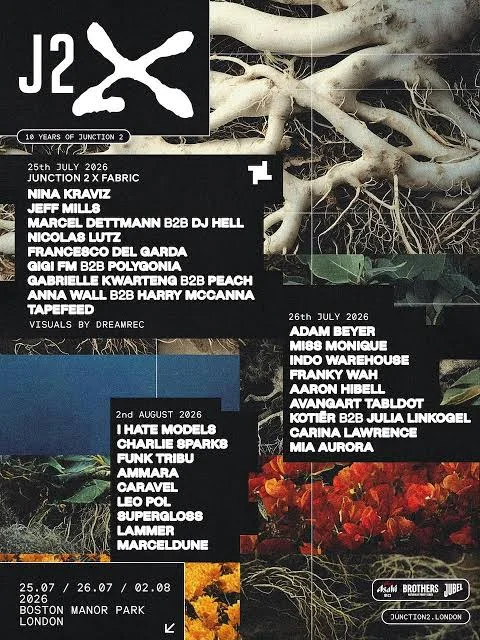
LWE did not improvise a picnic. It brought curated stages: Drumcode, The Hydra, Closer. Each name is a booking politics. Drumcode carries Adam Beyer’s techno; The Hydra lends the ear of a club that already knew how to mix house and techno without turning them into a menu; Closer is the house’s own night. The opening bill — Dixon, Carl Craig, Nina Kraviz, Adam Beyer, Marcel Dettmann, Âme, Mano Le Tough, Scuba, Pan-Pot — is not a list for showing off. It is proof that the first day was already programmed as a meeting of scenes, not a warm-up. Anyone who reached Boston Manor in 2016 did not go to a rehearsal. They went to a thesis tested in daylight.
The debut licence is cited around 9999. The number matters because it draws a line: Junction 2 was not born to be a fifty-thousand compound. It was born to fit a neighbourhood park with a capacity you can walk. The crowd arrives from Zone 4 stations, crosses streets of housing and suddenly the lawn sounds like peak-time techno. That arrival — city, not a pilgrimage to a rented field — belongs to the experience. There is no need to invent farm mud. There is a municipal park that on a Saturday stops belonging only to whoever walks the dog and becomes a map of stages between the Brent and the trees.
No VIP and no plastic: those two refusals are the character. In a London of hospitality by bleachers and catalogue-white canvas, LWE bet on a site that does not separate the person who pays more. Loud sound outdoors is not a metaphor for freedom. It is a production decision: the park holds the volume, the crowd moves between stages on foot, and the horizon is not a branded fence. Anyone hunting a sofa zone with its own toilet has the wrong festival. Anyone hunting a Drumcode set with sky above it does not.
The audience experience is urban and compact. You walk little compared with a valley site; you choose a lot compared with a one-room club. House on one stage, drum and bass on another, techno occupying the centre of the thesis. The genre crossing is not a compromise. It is London: a city that already mixed those floors in docks and basements, and that here puts them under the same leaf canopy. June weather can be pressing sun or rain that turns grass to puddle; the park does not negotiate. Anyone coming off the Piccadilly line is not looking for a campsite. They are looking for a day — sometimes longer — when West London sounds louder than the traffic.
The venue explains the music as much as the bill. Boston Manor Park has water, a gentle slope, buildings that remind you this is not a festival wasteland. The Brent is not the postcard Thames. It is a suburban river that passes while a Marcel Dettmann or Pan-Pot set pushes the air. That friction — family park, warehouse techno — is what LWE wanted to keep. The point is not to ruralise electronics. The point is to put them on the lawn without dressing them as a fair.
Junction 2 is not told here as a season or a promise. It is told as a 2016 project that put a site politics in front of marketing: volume, curated stages, park capacity, zero VIP. Specialist coverage marks it as the open-air where London Warehouse Events translated its dock ear to a garden on the Ealing and Hounslow edge. The legacy of that translation does not need a slogan. It needs the park map and the names of the nights that occupied it.
There is no need to turn the text into a chronology of bills. What matters is the arc: a warehouse promoter that decided techno deserved grass, a Zone 4 river, a capacity you can walk, a first day that already sounded like Dixon and Carl Craig. West London lent the park. LWE lent the stubbornness. What remains is a festival best understood as a Closer night that learned to last in daylight.
Anyone crossing Boston Manor Park between a Drumcode stage and a Hydra stage is not choosing a generic Greater London open-air. They are choosing a site that was born so techno could play loud without a paid sofa, with the Brent beside it and without a catalogue tent covering the sky.
Genres
DRUM & BASS
HOUSE
TECHNO
Timeline
One artist per year — highest ranked in our archive
Those who appear most across this franchise's editions.
 #1
#1Russia
3 editions · 2023–2026
 #2
#2Sweden
2 editions · 2023–2026
 #3
#3United States
2 editions · 2023–2026