Ranking
#620

ELECTRONIC ROCK - METAL
Ranking
#620
Followers
89.3 K
When
24–JUL 25, 2027
Where
Cologne
Country
Germany
Featured artists
Lineup coming — we'll publish it as soon as it's confirmed.
Time left
5 editions to explore · future, live and past
Numbers, home base and house quirks
Amphi Festival is one of the most important gatherings in Europe’s dark scene, but its strength does not lie only in black clothing, synthesizers, industrial guitars or gothic aesthetics. Its real identity lives in the sense of community it has managed to build across two decades in Cologne. Every July, the Tanzbrunnen becomes a parallel city on the banks of the Rhine: a city of boots, leather, lace, vinyl, shadows, make-up, electronic anthems, dense guitars, beer, mead, reunion hugs and a crowd that understands darkness not as isolation, but as a shared form of belonging.
The festival was born in 2005 in Gelsenkirchen, with a first edition that already made its musical map clear: In Extremo, Project Pitchfork, Camouflage, Die Krupps, Goethes Erben, Unheilig, Welle:Erdball, Blutengel and other essential names from different branches of German and European alternative culture. But its move to Cologne’s Tanzbrunnen in 2006 gave it its defining image. The venue is not just a logistical detail; it is central to Amphi’s character. Located beside the Rhine, with Cologne Cathedral visible across the water, open areas, a main stage, theatre spaces, places to rest and an urban but comfortable atmosphere, the site allows the festival to be intense without becoming hostile.
Unlike some larger, more rural or more scattered goth festivals, Amphi has a particularly recognizable scale. It does not feel like an endless expedition or a camping city where everything is far away. Its power lies in concentration: three stages, clear schedules, a loyal audience, market stalls, food, meeting points, an urban beach, river views and a circulation that lets you move from an EBM concert to a post-punk band, from synthpop to Neue Deutsche Härte, from darkwave atmosphere to industrial celebration without breaking the experience.
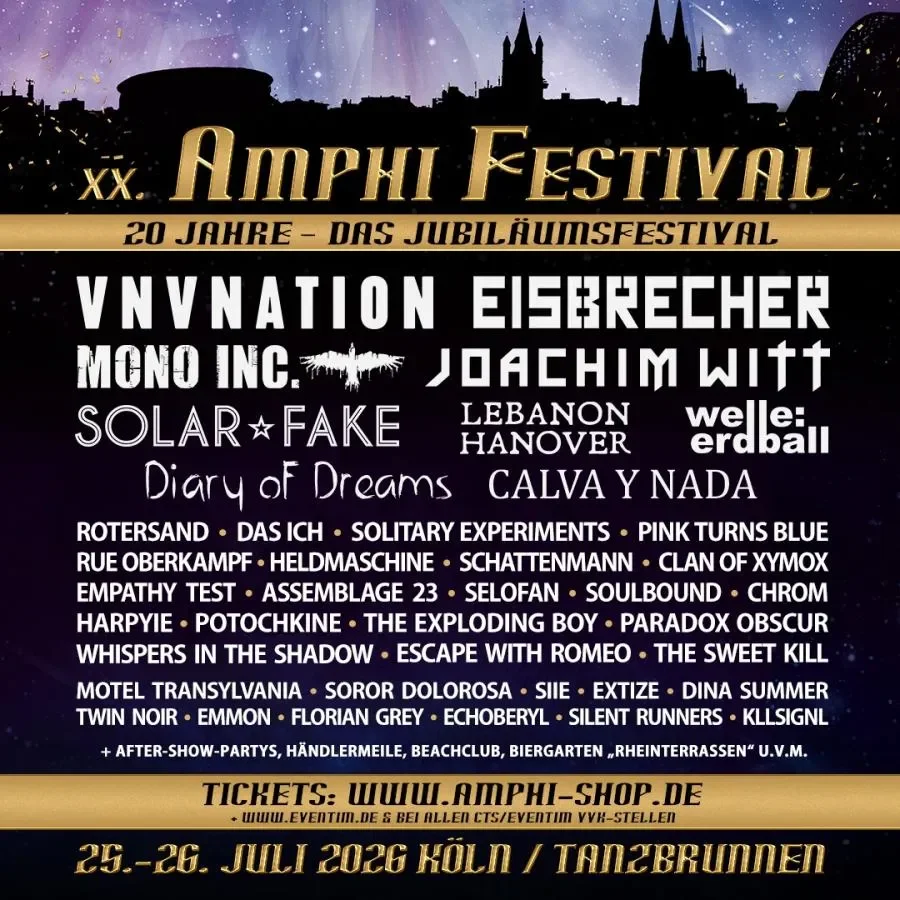
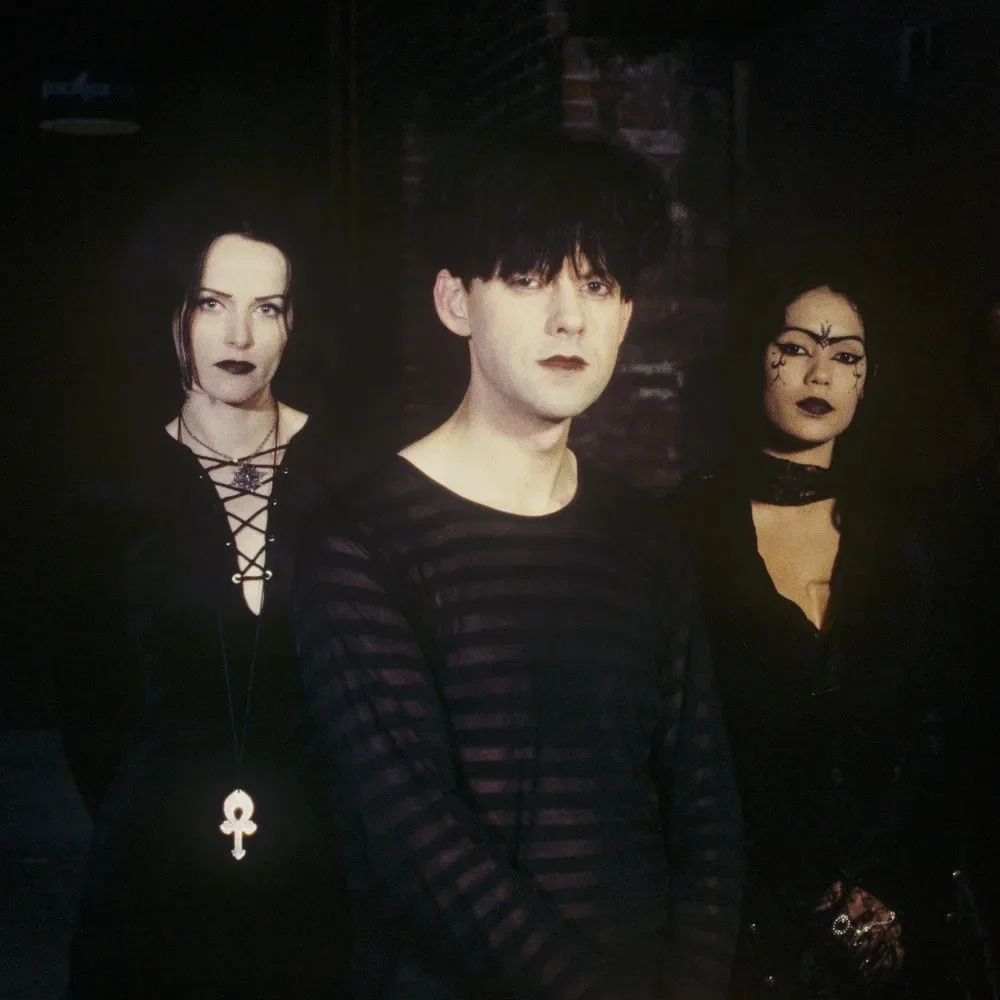
The 2026 edition captures very well what Amphi represents. VNV Nation brings the emotional and epic pulse of futurepop and dark synthpop; Eisbrecher represents the force of Neue Deutsche Härte and German industrial metal; Mono Inc. connects with broad-reaching gothic rock; Solar Fake, Assemblage 23, Rotersand, Solitary Experiments and Welle:Erdball sustain the electronic spine; Das Ich and Diary of Dreams add historical depth from the German scene; Pink Turns Blue, Lebanon Hanover, Clan of Xymox, Selofan, Rue Oberkampf and Empathy Test open lines of post-punk, coldwave, darkwave and more melancholic synthpop. The lineup works like a living genealogy of dark music.
That balance between memory and the present is one of the reasons Amphi remains relevant. It does not simply book classics for a nostalgic audience, although nostalgia is part of its charm. It also makes space for newer projects, fresh sensibilities, more minimal sounds, artists with contemporary readings of darkness and crossings between club culture, rock, performance and electronic music. In the dark scene, tradition matters, but Amphi understands that a community only stays alive if it allows new ways of feeling and dancing to enter.
The festival experience has something of an annual ritual. For many attendees, Amphi is not “just another concert.” It is a fixed date, a chosen-family reunion, a chance to see friends from other countries, plan outfits weeks ahead, buy records or clothes at the market, discover bands on the Theater Stage, sing anthems in front of the Main Stage and end the day by the Rhine with that mix of tiredness, smudged make-up and quiet happiness left by festivals that become part of personal tradition. The phrase “Amphi family,” used by the festival itself, does not feel like empty marketing here. It describes the audience’s relationship with the event quite well.
There is also something very German in its structure. Amphi combines efficiency, punctuality, comfort and alternative culture without losing warmth. The Tanzbrunnen has paved ground, fixed facilities, good accessibility, defined spaces and an organization that allows darkness to be lived with a certain ease. That does not reduce its intensity. On the contrary, it helps the audience focus on the music, the encounter and the atmosphere. Not every dark festival needs to be chaotic to feel authentic. Amphi proves that alternative culture can have solid infrastructure without losing its soul.
Its value lies in being one of the clearest expressions of the European urban dark festival. It is not only a gothic festival, because that word is too small. It is gothic, industrial, electronic, post-punk, synthpop, EBM, dark rock, Neue Deutsche Härte, futurepop, coldwave and alternative club culture in one circuit. Nor is it only a list of bands. It is an ecosystem of aesthetics, community, ritual, market, city, river and shared memory.
Amphi Festival matters because it has turned darkness into a luminous meeting point. Its strongest image is not a sad crowd, but the opposite: thousands of people dressed in black under the July sun, the Rhine flowing nearby, the Tanzbrunnen full, VNV Nation or Eisbrecher closing a night, friends embracing after a set, boots moving between stages and Cologne shining in a different way. At Amphi, dark music does not hide. It takes over the city, organizes itself, celebrates itself and proves that even in shadow there can be a deeply living community.
Genres
ELECTRONIC ROCK
METAL
Timeline
One artist per year — highest ranked in our archive
Those who appear most across this franchise's editions.
 #1
#1Germany
2 editions · 2023–2026
 #2
#2Netherlands
2 editions · 2023–2026
 #3
#3Germany
2 editions · 2023–2026