Ranking
#630

HOUSE - TECHNO - TRANCE
Ranking
#630
Followers
87.9 K
When
2027
Featured artists
Lineup coming — we'll publish it as soon as it's confirmed.
7 editions to explore · future, live and past
Numbers, home base and house quirks
Polifonic is not the kind of festival where people enter a fenced site and remain inside it until the final track fades. It unfolds across a piece of southern Italy. One evening begins beside the Adriatic as the light drops over the water; another requires a drive along rural roads towards an old masseria surrounded by pale stone, dry land and olive trees; the closing session returns to the coast, allowing the weekend to loosen its grip beside the sea. That movement between landscape, architecture and sound has defined the festival from the beginning.
Founded in 2017 in Puglia’s Itria Valley, Polifonic emerged with an idea that went beyond placing international DJs in a summer destination. Electronic music would be set inside a region with its own visual language, culinary culture and deep sense of place. House, techno, disco and experimental electronics could exist alongside whitewashed towns, agricultural land and the two coastlines surrounding the valley. The setting was not intended as a decorative backdrop. It became one of the tools through which the programme was experienced.
The project later expanded beyond Puglia. Polifonic developed a record label, organised showcases elsewhere and launched a Milan edition, translating its values into an urban environment. Yet the southern festival remains its emotional centre. In the Itria Valley, the connection between music and territory is at its clearest, and the event operates as a route rather than a single destination. Beach venues frame the beginning and end, while Masseria Capece in Cisternino carries the weight of the central nights.
This multi-venue structure changes the practical rhythm of attending. Polifonic is not a self-contained camping world where everything is reached on foot. Visitors stay in towns such as Fasano, Cisternino, Monopoli, Ostuni, Locorotondo or Torre Canne, then plan transport between accommodation and the venues. Rural roads, late journeys and the search for a reliable meeting point become part of the week. Days can be spent eating near the coast, moving slowly through the afternoon heat and arriving while there is still enough daylight to understand the surroundings before stage lighting takes over.
Musically, the name is more than branding. House and techno provide the foundations, but the curation repeatedly stretches into disco, electro, breaks, dub, ambient, bass music and live performance. Vinyl-focused selectors appear beside producers associated with Detroit, London, Berlin, Italy and the wider Mediterranean. A set can begin with warm, open rhythms and become stranger as the night deepens. Established figures do not occupy a separate world from emerging artists; they are placed inside the same sequence, encouraging the audience to stay for a sound rather than visit only for one headline name.
Masseria Capece is where the festival’s nocturnal personality becomes most visible. Stone walls and rural spaces are temporarily fitted with stages, lighting and dancefloors, but the production does not attempt to erase the masseria beneath it. The contrast is the point: contemporary electronic music filling a place shaped by agricultural history. Cala Maka brings a different pace, opening the festival beside the Adriatic, while the Sunday session at Le Palme Beach Club replaces the intensity of the central nights with a coastal closing chapter that can still stretch well beyond sunset.
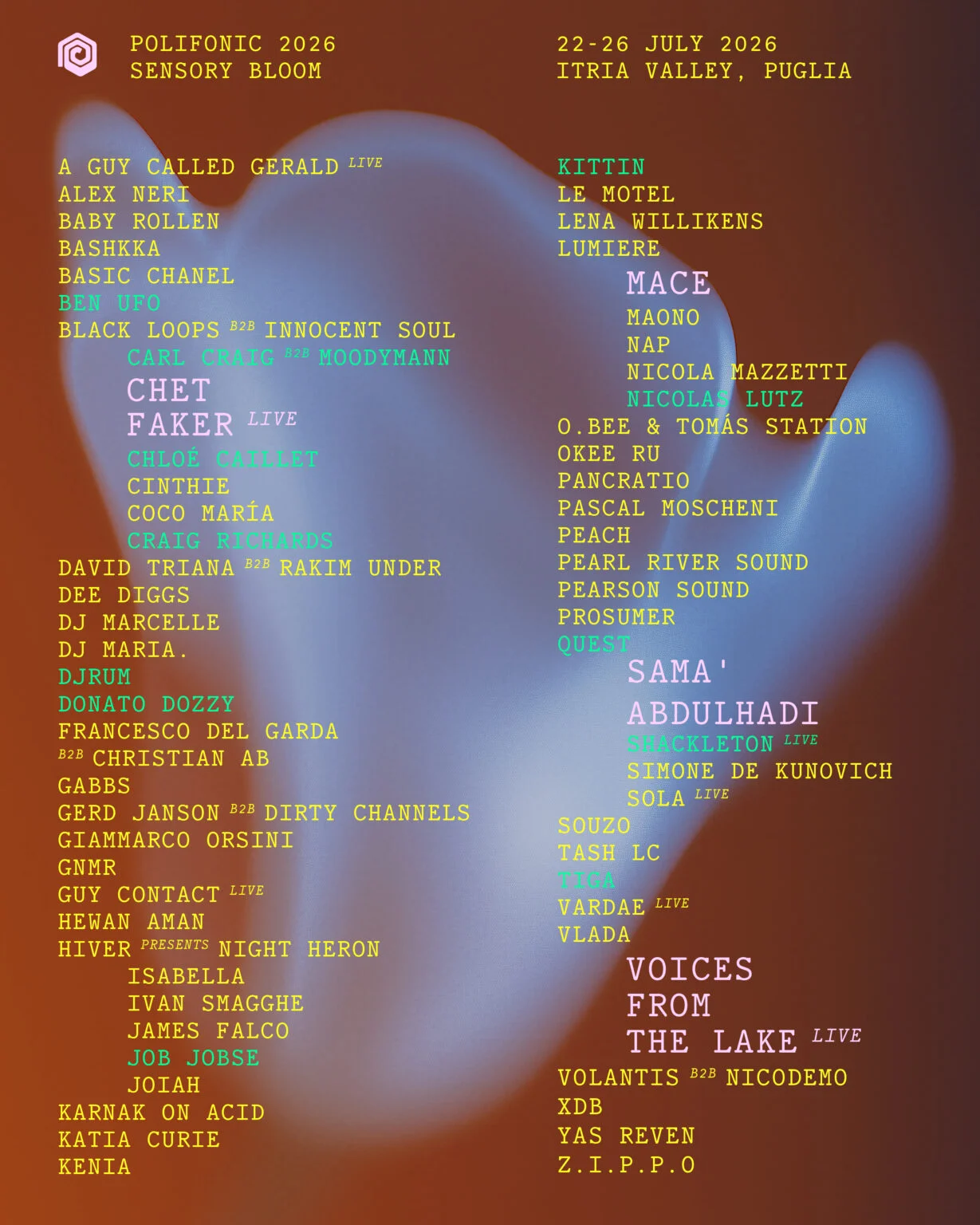
The eighth Puglia edition runs from 22 to 26 July 2026 under the theme Sensory Bloom. Its programme includes Carl Craig b2b Moodymann, Chet Faker live, Ben UFO, Donato Dozzy, Voices From The Lake live, A Guy Called Gerald live, Kittin, Tiga, Job Jobse, Chloé Caillet, Djrum, Sama’ Abdulhadi and dozens of other artists. The scale is substantial, but the lineup is presented less as a collection of oversized headliners than as a broad spectrum of club history, contemporary experimentation and future-facing dance music.
Polifonic’s character lies in the balance it maintains: careful selection without draining the dancefloor of pleasure, international reach without disguising its Italian roots, and contemporary production placed inside landscapes that existed long before the festival arrived. The lasting image is rarely one isolated stage. It is the full journey—the road through the valley, the first view of the sea, stone glowing after sunset and the moment when another morning begins while the music is still moving.
Genres
HOUSE
TECHNO
TRANCE
Timeline
One artist per year — highest ranked in our archive
Those who appear most across this franchise's editions.
 #1
#1Netherlands
2 editions · 2023–2026
 #2
#2Switzerland
2 editions · 2023–2026
#3Italy
2 editions · 2023–2026